
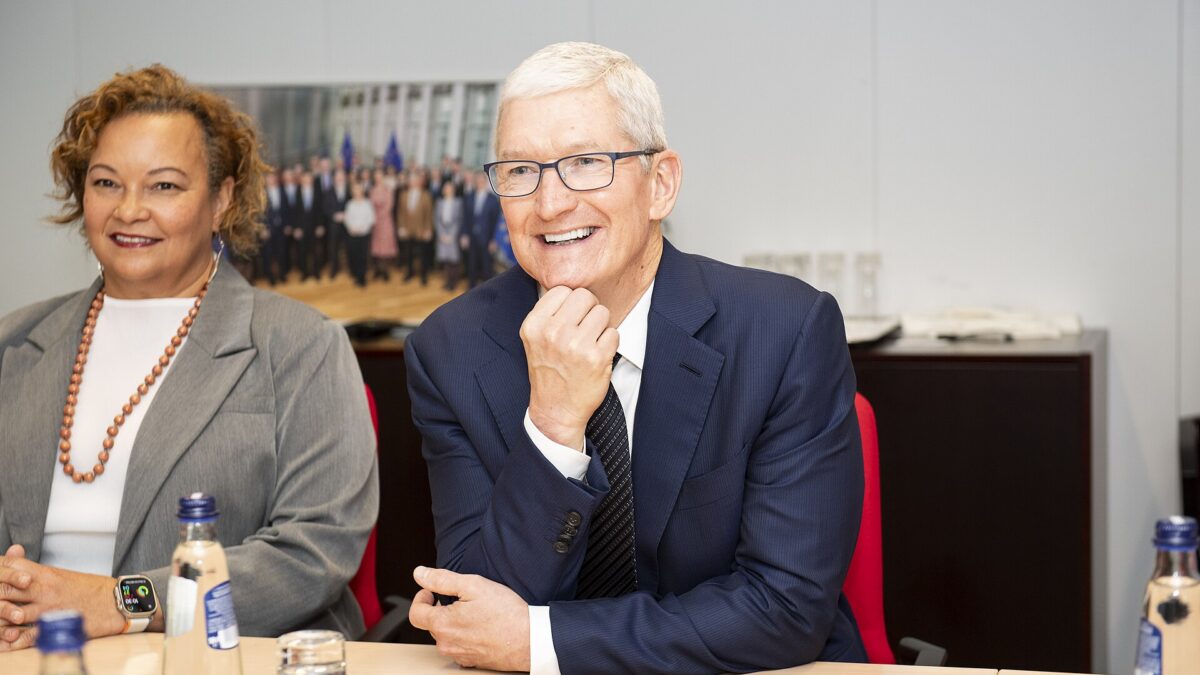
Tim Cook’s childhood and parents helped establish the work ethic and practical outlook that later defined his career. He grew up in Robertsdale, Alabama, a small rural community near the Gulf Coast, in a family where working was treated as a normal responsibility. His father worked at a shipyard, while his mother worked at a local pharmacy, according to reporting from CNBC’s account of Tim Cook’s early life.
Cook has generally kept details about his family private. Public accounts do not establish his parents’ names or provide a detailed portrait of their home life, so the clearest evidence concerns the values and circumstances he has described himself: work was expected, education mattered, and money had to be handled carefully. Those facts offer a more grounded explanation of his beginnings than later assumptions about how a future Apple CEO was shaped.
A working-class childhood in Robertsdale
Timothy Donald Cook was born on November 1, 1960, and was the second of three sons, according to the EBSCO Research Starters profile of Tim Cook. He was raised in Robertsdale, a farm town in Baldwin County, Alabama. The available record describes a modest upbringing rather than one connected to technology, finance or corporate power.
His father’s shipyard job and his mother’s work in a pharmacy placed Cook in a household familiar with regular employment and practical routines. CNBC quoted Cook saying, “Everybody was expected to work in my family.” That comment is significant because it describes work not as a dramatic breakthrough but as an ordinary part of growing up. Before he became associated with Apple’s global supply chain, Cook had already learned the discipline of showing up and completing routine tasks.
Some details about the family’s finances have been reported secondhand. CNBC cited a Washington Post account saying the family could not afford a typewriter. That detail should be treated as context, not as a complete measure of the family’s circumstances. It does, however, fit the broader evidence that college required planning and personal effort rather than being an automatic next step.
Why Cook started working at 12
Cook began delivering the Mobile Press Register at age 12 to save money for college. He told the Wall Street Journal, as quoted by CNBC, that throwing newspapers “helped start my college education.” He recalled waking at about 3 a.m. to collect a stack of papers, deliver them, return home for a short nap and then go to school.
The newspaper route was an early job, not the beginning of a technology career. Its importance was financial and personal: Cook connected work with the opportunity to attend college. He did not disclose exactly how much he saved or what portion of his tuition the earnings covered. CNBC also reported that he worked part time at a local pharmacy, although that detail was attributed to a 2019 biography rather than to a public record released by Cook’s family.
Cook later described college as a privilege he needed “not to waste.” That phrase helps explain the link between his childhood and his education. The evidence does not show that he had a detailed plan to become a corporate executive. It shows a young person who understood that education could open opportunities and who took paid work seriously enough to help make it possible.
School years and the path to Auburn
At Robertsdale High School, Cook was a member of the marching band and graduated second in his class, according to EBSCO. He was also voted “most studious.” These details point to a strong academic record, but they should not be turned into a larger personality claim than the sources support. EBSCO describes him as quiet and reserved during his university years; it does not establish that he was destined for executive leadership as a teenager.
Cook attended Auburn University, where he studied industrial engineering. CNBC reported that the in-state tuition was $660 per year when he matriculated, while Auburn’s current listed tuition is far higher. Historical tuition comparisons can be useful, but inflation-adjusted figures are estimates and do not show exactly what Cook or his family paid. The more secure point is that Auburn gave him the technical foundation for a career in operations, manufacturing and distribution.
Cook graduated from Auburn in 1982. He later earned a Master of Business Administration from Duke University in 1988 while working full time, according to EBSCO. That combination—engineering training followed by business education—became especially relevant to his early professional choices. His career would develop around how companies move products, manage inventory and coordinate large systems, rather than around designing consumer devices himself.
From IBM to Apple: the first career decisions
After Auburn, Cook joined IBM in North Carolina. He spent 12 years there and eventually became director of North American fulfillment, with responsibility for manufacturing and distribution of IBM personal computers in the Americas. EBSCO describes him as reliable and notes that he volunteered to work over Christmas so the company could complete orders before the end of the year.
Cook left IBM in 1994 for Intelligent Electronics, where he began in the computer reselling division and rose to chief operating officer. He moved to Compaq in 1997 and spent about six months there before Apple recruited him in 1998. CNBC reported that he joined Apple as senior vice president for worldwide operations.
That move was a career risk. Apple’s sales had declined, and the company had lost $1 billion the year before Cook arrived, according to EBSCO. His early work at Apple focused on supply-chain problems, excess inventory, warehouses and distribution. He viewed inventory as a cost that should move quickly through the business, and he helped reduce stock levels, close warehouses and rely more heavily on outside manufacturing partners.
In that sense, Cook’s career beginnings were closely connected to his childhood without being identical to it. His parents’ jobs did not predetermine his profession, and there is no evidence that his newspaper route directly taught him corporate logistics. But the public record does show a consistent thread: a modest Alabama upbringing, early paid work, serious investment in education and a willingness to build expertise through demanding operational roles.
For the broader timeline, see the Newsr profile of Tim Cook. This early-life account is narrower: it focuses on the family background, childhood work and first professional decisions that came before his public leadership at Apple.
Tim Cook’s rise began less with technology access or inherited business influence than with a working Alabama childhood, an early newspaper route and a deliberate investment in education. His first professional roles then turned that practical foundation into expertise in operations and supply chains.