
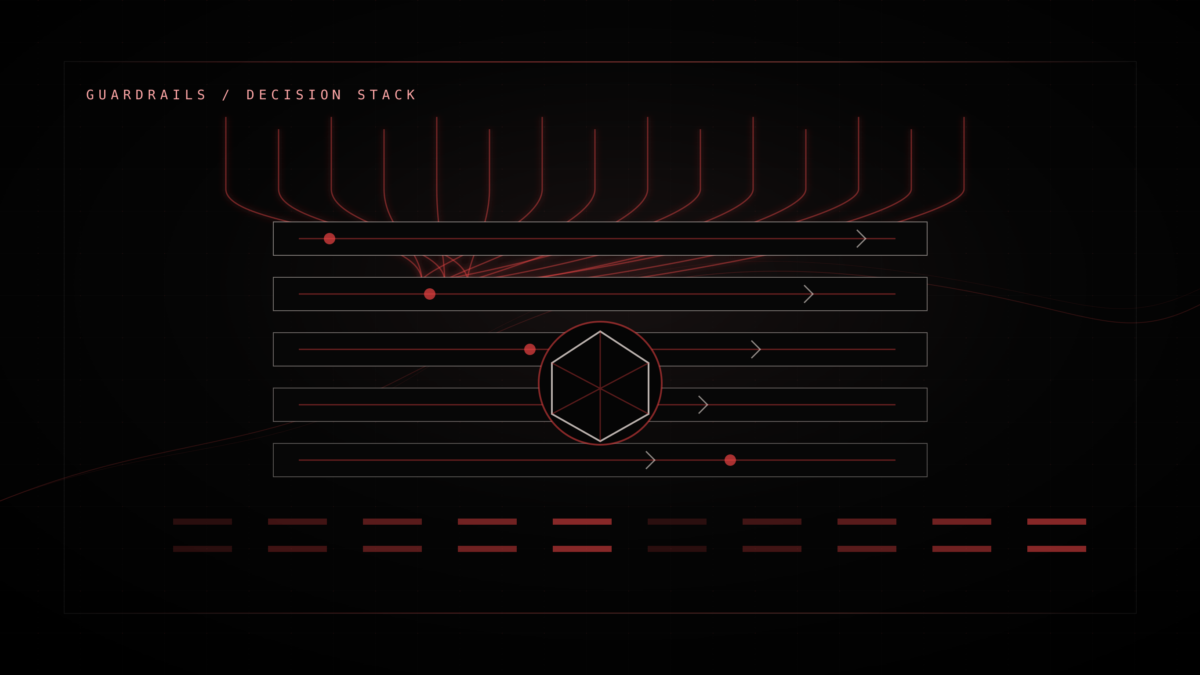
For a cannabis company considering an AI assistant, the useful question is not simply which guardrail product is “best.” It is where the control sits, what it can stop and what evidence shows that it works in the company’s own workflow. The supplied 2026 guides support a general evaluation framework, but they do not verify that any platform is best for cannabis businesses specifically.
That distinction matters because an AI system can create risk before it generates an answer, while it acts through tools and after it produces text. A content filter may catch an unsafe response, but it does not necessarily prevent sensitive information from entering a model or stop an agent from calling an unauthorized service.
Start with the data owner’s problem
Operations, marketing and customer-support teams may want different controls from compliance or security staff. A team handling contracts, customer records or other sensitive material should first examine input protection. Protecto describes input guardrails that mask or tokenize personally identifiable information before a prompt reaches a model. That can reduce exposure at the point where data leaves the application, although the supplied evidence does not independently verify the performance of those controls.
Output checks address a different failure point. They can scan generated responses for sensitive data, unsafe content or other policy violations. The mechanism is straightforward: the system evaluates the model’s response before it reaches a user or downstream application. It is not the same as changing the model’s underlying knowledge or reasoning.
General Analysis makes that distinction explicit: alignment at training time may make undesirable behavior less likely, while runtime guardrails limit what the system can receive, produce or do in a particular context. A cannabis company should therefore treat guardrails as one layer of system control, not as proof that the model itself is reliable.
Security teams need controls around actions
The highest-consequence decision often concerns tool access rather than wording. An AI agent connected to business systems can potentially retrieve information, trigger workflows or call application programming interfaces. The General Analysis guide defines guardrails broadly enough to include policy engines that restrict privileged API calls and controls that scope tool use.
That creates a clear stakeholder split. Developers need controls they can place in the request path. Security teams need permission boundaries and testing against hostile inputs. Managers need evidence that policies apply consistently across applications rather than being re-created in each individual feature.
Maxim AI’s guide presents a gateway approach through Bifrost, where policies can be applied across model providers and consumers. It also describes input and output checks, PII redaction, audit logs and rules-based enforcement as evaluation criteria. Those are claims made in the source’s product comparison, not independent test results. A buyer should verify the exact integrations, logging behavior and enforcement path directly in implementation documentation.
Compare platforms by trade-offs, not rankings
The supplied guides name GA Guard, NeMo Guardrails, Llama Guard, Lakera Guard, OpenAI Moderation, Guardrails AI and Bifrost among the tools to compare. They do not establish a neutral winner. Instead, a durable comparison should use four questions.
- Coverage: Does the control inspect inputs, outputs and agent actions, or only generated text?
- Deployment: Can one policy cover multiple model providers, or must each application implement its own checks?
- Privacy and auditability: Can sensitive data be masked before processing, and are decisions recorded in logs that the organization can review?
- Reliability: What latency does enforcement add, and how does the system behave when a guardrail service is unavailable?
These criteria expose the main cost trade-off. More checks can improve coverage, but every additional validation step may add operational complexity and response time. The evidence pack does not provide a verified price comparison, latency benchmark across all named products or cannabis-specific failure rate. Those gaps should be treated as purchasing questions, not filled with assumptions.
What a responsible pilot should prove
A pilot should use representative prompts and document four outcomes: what sensitive data was blocked or masked, which unsafe requests were rejected, whether unauthorized tool calls were prevented and how decisions were logged. It should also measure response behavior when a control fails or cannot classify a request.
The conclusion can change after that testing. If a company only needs text moderation, a narrower control may be sufficient. If its AI system handles sensitive records or takes actions in connected software, input protection, permission boundaries and audit trails become more important than a simple output filter.
For now, the evidence supports a method rather than a product verdict: map each AI action to a control point, verify the provider’s implementation claims and test the resulting system under realistic conditions.
The current evidence does not establish a best AI guardrail platform for cannabis companies. It does support a practical buying framework: separate input protection from output moderation, examine controls over tools and privileged APIs, and verify whether policies can be applied consistently across model providers. Privacy, auditability and latency should be tested in the organization’s own workflow because the supplied guides do not provide independent cannabis-specific benchmarks, verified pricing or universal performance results. The next useful milestone is a documented pilot that records blocked data, rejected requests, prevented tool calls and system behavior during control failures.
Sources and methodology
- Best AI Guardrails in 2026: Tools, Architecture, and How to ... - https://generalanalysis.com/guides/best-ai-guardrails
- Top 5 Platforms to Implement AI Guardrails in 2026 - https://www.getmaxim.ai/articles/top-5-platforms-to-implement-ai-guardrails-in-2026
- 5 Types Of AI Guardrails You Must Know In 2026 - https://www.protecto.ai/blog/types-of-ai-guardrails-explained
- Choosing the Right AI Agent Builder in 2026 - https://www.gend.co/blog/ai-agent-builder-guide-2026