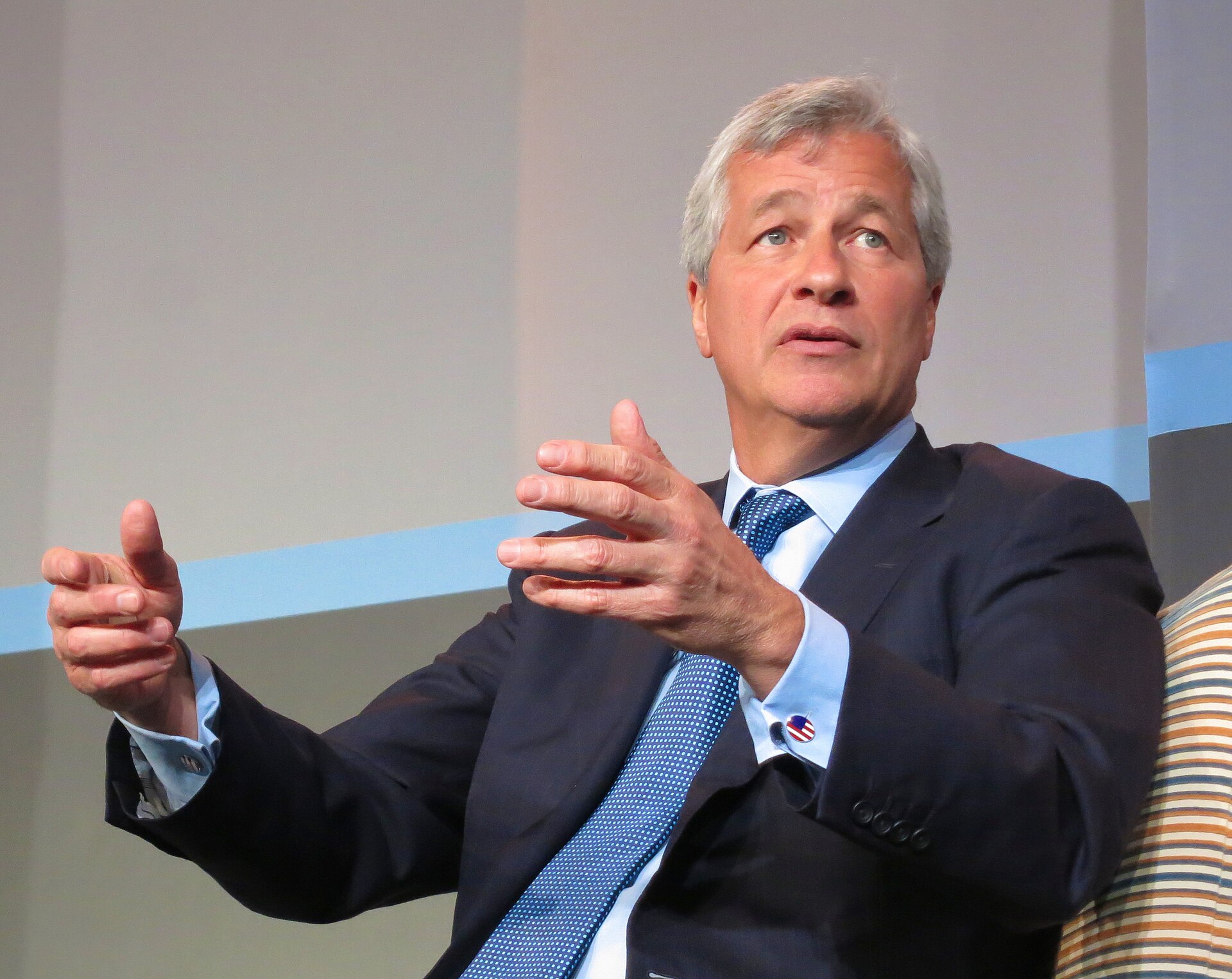


Jamie Dimon’s estimated net worth is $3.2 billion as of August 31, 2026, according to Forbes. His wealth comes primarily from JPMorgan Chase stock, executive compensation and decades of senior leadership in financial services – not from a portfolio of consumer brands or publicly documented startup ventures. His career has moved through American Express, Commercial Credit, Travelers, Smith Barney, Citigroup, Bank One and JPMorgan Chase.
For readers looking for the broader personal context, the Newsr profile of Jamie Dimon covers his background separately. This article focuses on the business path that produced his wealth and the limits of available net-worth estimates.
A career built through financial-services deals
Dimon began his professional career after earning an MBA from Harvard Business School in 1982. According to JPMorgan Chase, he started at American Express before moving into the leadership orbit of Sandy Weill at Commercial Credit. The company became a platform for acquisitions and divestitures, including the purchase of Primerica Corporation in 1987 and The Travelers Corporation in 1993.
Dimon became chief financial officer and later president of Commercial Credit. He then served as president and chief operating officer of Travelers from 1990 through 1998, while also holding a senior operating role at Smith Barney. Following the 1997 merger of Smith Barney and Salomon Brothers, he became co-chairman and co-chief executive of the combined brokerage, according to JPMorgan Chase’s official leadership biography.
These roles mattered because they placed Dimon inside a consolidation strategy that combined lending, insurance, brokerage and investment-banking businesses. In 1998, Travelers Group and Citicorp combined to form Citigroup, and Dimon became president of the new financial-services company. His tenure there ended later that year after a separation from Weill. The departure is a documented turning point in his career, but the supplied sources do not establish a single definitive public explanation for the disagreement.
Bank One was the pivotal operating test
In 2000, Dimon became chairman and chief executive of Bank One, then one of the largest U.S. banks. The move gave him direct responsibility for a major banking franchise rather than an executive role within Weill’s broader acquisition machine.
Accounts cited in the supplied material describe Bank One as a money-losing lender that returned to strong profitability during Dimon’s leadership. The most important business consequence was strategic: JPMorgan Chase acquired Bank One in 2004, and Dimon became president and chief operating officer of the combined company. JPMorgan Chase says he became CEO on January 1, 2006, and chairman of the board one year later.
This succession made the Bank One transaction more than a corporate merger. It became the route through which Dimon reached the top of one of the world’s largest financial institutions. His career therefore reflects both operating management and deal-making: he helped assemble financial businesses earlier in his career, then used a large-bank leadership role to establish a long-term position at JPMorgan Chase.
How JPMorgan Chase became the center of his business profile
JPMorgan Chase is the dominant company in Dimon’s public business profile. The bank describes itself as a global financial-services firm with $3.2 trillion in assets and operations around the world. Its businesses include investment banking, consumer and small-business banking, commercial banking, payment processing and asset management.
Forbes identifies Dimon as the company’s CEO and describes JPMorgan Chase as the largest U.S. bank by assets. His compensation and personal investment exposure have grown alongside the institution. That does not mean the bank’s entire value belongs to him; it means that a substantial portion of his personal wealth is connected to the market value of JPMorgan Chase shares and to awards granted for his service as chief executive.
Forbes also reports that Dimon’s move to sell $12 billion of subprime mortgages in 2006 helped buffer JPMorgan Chase against the 2008 financial crisis. That description is Forbes’ assessment of a major strategic decision, not a standalone measure of personal wealth. It helps explain why Dimon’s tenure is often evaluated through the bank’s risk management, acquisitions, earnings and market performance rather than through separate entrepreneurial ventures.
What the net worth estimate includes – and what it does not
Forbes lists Dimon’s real-time net worth at $3.2 billion as of August 31, 2026. This is an attributed estimate, not a government-certified figure or a complete public accounting of every asset and liability. Forbes classifies his source of wealth as banking and identifies him as self-made.
The estimate can change with JPMorgan Chase’s share price, the vesting or sale of equity awards, taxes, compensation and other investments. A 2023 report from the Rogue Valley Times, based on a JPMorgan Chase Securities and Exchange Commission filing, said Dimon and his family held 8.6 million shares and that Dimon had slightly more than 2 million unvested shares at that time. The report estimated that the holdings and unvested awards were worth about $1.5 billion at the stock price then available, and placed his likely net worth at roughly $1.7 billion or more.
That older estimate should not be substituted for Forbes’ August 2026 figure. It is useful mainly because it shows the mechanism behind Dimon’s wealth: publicly traded equity and accumulated executive compensation. Share counts, stock prices and award status change, so historical calculations can quickly become outdated.
Compensation has been heavily incentive-based
Dimon’s base salary has been only one part of his compensation. The Rogue Valley Times reported that his 2022 base salary was $1.5 million and that his total compensation for that year was $34.5 million, including $33 million in performance-based incentives.
That structure helps explain why a chief executive’s annual salary cannot be used as a proxy for net worth. Over a long tenure, restricted stock, bonuses and other incentive awards can compound into a large equity position. At the same time, the value remains exposed to market risk. If JPMorgan Chase shares decline substantially, the value of Dimon’s holdings and unvested awards can fall even when his compensation history remains unchanged.
Companies and ventures: a focused record
Dimon’s documented business career centers on companies in banking and financial services:
- American Express: His entry point into finance after Harvard Business School.
- Commercial Credit: He served as chief financial officer and president during a period of acquisitions and divestitures.
- Travelers and Smith Barney: He held senior operating positions during the formation of a major financial-services group.
- Citigroup: He became president after the Travelers Group – Citicorp combination.
- Bank One: He served as chairman and CEO from 2000 until its merger with JPMorgan Chase.
- JPMorgan Chase: He has served as CEO since 2006 and chairman since 2007, according to the company.
The supplied evidence does not show Dimon building a separate, recognizable consumer company or venture-capital empire outside financial services. His business legacy is instead tied to institutional management, mergers, capital allocation, risk decisions and the long-term performance of JPMorgan Chase. For a second reference point on Jamie Dimon’s career and public profile, see the related Newsr article.
Jamie Dimon's wealth is best understood as the product of a long financial-services career, substantial JPMorgan Chase equity exposure and performance-based compensation - not as the result of a standalone startup empire.
Sources and methodology
- JPMorgan Chase leadership biography: https://www.jpmorganchase.com/about/leadership/jamie-dimon
- Forbes profile and net worth estimate: https://www.forbes.com/profile/jamie-dimon/
- Jamie Dimon biography: https://en.wikipedia.org/wiki/Jamie_Dimon
- Rogue Valley Times compensation and net worth analysis: https://rv-times.com/2023/11/08/jamie-dimons-net-worth-base-pay-incentives-billionaire-status/