

Phil Tippett Studio is closing its longtime Berkeley, California, facility and selling a large collection of props, models, artwork, tools and production equipment during a three-day liquidation sale scheduled for Aug. 28-30, 2026. The available reporting supports the closure and sale, but it does not establish the full terms, prices, payment methods, pickup rules or whether every item shown in coverage will still be available. Buyers should treat the event as a liquidation sale with details to verify directly through the sale organizer.
What the reports confirm
Cartoon Brew reported that the 6,200-square-foot Tippett Studio facility was being emptied in a three-day sale running through Sunday. Berkeleyside separately reported that Clarity Estate Liquidation scheduled the sale for Aug. 28, 29 and 30, 2026, describing it as part of the studio’s bankruptcy proceedings.
The reports agree on the basic consequence: a Berkeley visual-effects landmark is clearing out its facility after decades of work. The sources describe the studio as having operated in the location for roughly four decades, although Cartoon Brew specifically said Phil Tippett had occupied the Berkeley site for 35 years. The difference may reflect different starting points or definitions of the studio’s history, so the safest conclusion is that the location has been used for decades.
What may be available to buyers
The reported inventory spans both finished screen artifacts and the infrastructure used to make them. Coverage lists stop-motion and motion-capture equipment, cameras, model-making tools, production documents, computers, 3D printers, lighting equipment, welding gear, drill presses, mold-making equipment and toolboxes.
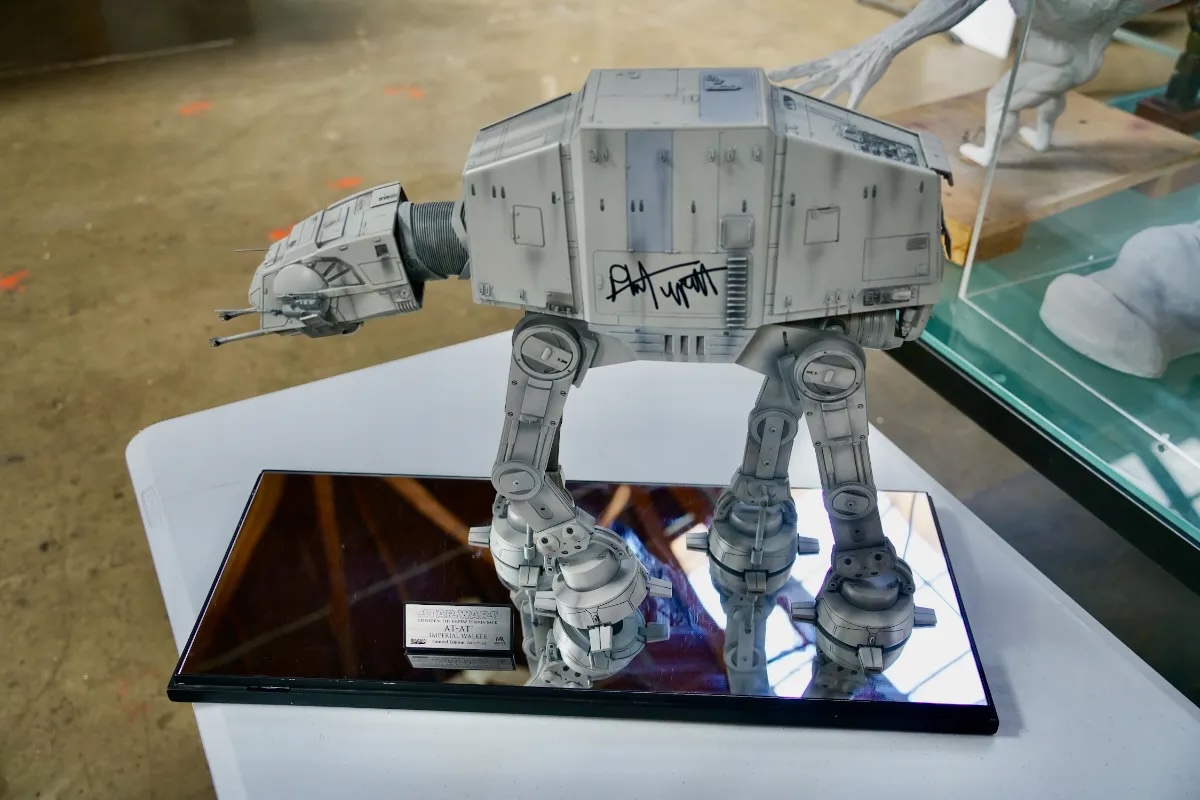
Collectors may also encounter objects associated with Tippett’s film work. Reported examples include models and sketches from Mad God, an artist-proof AT-AT model connected to The Empire Strikes Back, Starship Troopers miniatures, signed posters, storyboards, costumes, prototypes and three models connected to the Dejarik chess sequence in the original Star Wars.
Those descriptions are evidence of items identified by the publications, not a guarantee that each item remains in the sale or that any particular object is authentic, complete or available at a stated price. The supplied evidence contains no verified price list, lot numbers, condition reports, buyer’s premium, refund policy or shipping information.
The Oscars are excluded
One boundary is clear in the reporting: Tippett is keeping his Academy Awards. Cartoon Brew and Berkeleyside both reported that the Oscars connected to Return of the Jedi and Jurassic Park would not be sold.
That distinction matters because the sale’s broad descriptions could otherwise suggest that every significant object from Tippett’s career is included. The evidence supports a large disposal of studio contents, not the sale of those awards.
Does the sale prove the entire company is gone?
Not by itself. The closure of a facility and liquidation of its contents are strong evidence that the Berkeley operation is ending or being substantially reduced. They do not, without a company statement or other primary document, establish the final legal status of the business, the fate of employees, or whether any special-effects work continues elsewhere.
A discussion on the photomacrography.net forum illustrates the uncertainty. One participant described the event as a liquidation of the entire Berkeley studio. Another suggested it could follow a prior restructuring or simply involve older equipment. A later comment noted that the studio was still described elsewhere as actively developing special effects. These comments are not independent confirmation, and the available evidence does not resolve the question.
Berkeleyside quoted Tippett describing himself as retired from the film business and identified the sale as part of bankruptcy proceedings. That supports a significant transition, but it should not be expanded into an unsupported claim that every related operation, project or business relationship has ended.
What prospective buyers should verify
Anyone considering the sale should confirm the practical details before traveling or budgeting for a purchase. The supplied evidence identifies Clarity Estate Liquidation as the organizer and gives the sale dates, but it does not provide a verified address, opening hours, admission procedure, payment methods, pickup deadline or shipping option.
- Confirm the exact Berkeley location and daily hours from the current sale listing.
- Check whether an item is sold by auction, fixed price or another process.
- Review condition information and whether purchases are final.
- Ask how large equipment must be removed and whether buyers provide their own transport.
- Verify any buyer’s premium, sales tax, deposits or payment restrictions before bidding or purchasing.
These checks are especially important for industrial equipment and fragile models. A photograph or publication description can establish that an object was displayed or listed, but it cannot establish working condition, completeness, ownership history or a buyer’s legal right to reproduce a film-related design.
The next verifiable milestone
The immediate milestone is the Aug. 28-30, 2026, sale itself. Updated organizer information, a complete catalog, or a statement from Tippett Studio or its representatives could clarify what is being sold and whether the Berkeley closure marks the end of all studio activity or only the emptying of this facility.
For now, the evidence supports a narrower conclusion: a major Berkeley effects studio is closing its longtime location, and a three-day sale is offering a broad selection of its physical contents. It does not support assuming that every artifact is available, that the business has no continuing operations, or that a reported object will sell for any particular amount.
Phil Tippett Studio's Berkeley closure is best understood as a verified facility liquidation with an unresolved business-status question. Two independent reports identify a three-day Aug. 28-30, 2026, sale involving props, models, artwork, memorabilia and working effects equipment, while both distinguish the Oscars as excluded. The practical buyer issue is not whether the collection is historically significant, but whether individual lots, prices, condition, payment rules and removal requirements can be confirmed. The sale organizer's updated listing or a company statement would establish those missing details and clarify whether any studio work continues elsewhere.
Sources and methodology
- Phil Tippett’s Historic Berkeley Studio Closes with Liquidation Sale - https://www.photomacrography.net/forum/viewtopic.php
- Phil Tippett Closes Berkeley Studio After Nearly 40 Years - https://www.cartoonbrew.com/auctions/tippett-studio-closing-auction-266120.html
- Legendary Berkeley special-effects studio holding huge ... - https://www.berkeleyside.org/2026/08/27/star-wars-memorabilia-for-sale-tippett-studio-closure
- Tippett Studio Closes After 35 Years Of Animation Innovation - https://www.starwarsnewsnet.com/2026/08/tippett-studio-closes-after-35-years-of-animation-innovation-original-star-wars-models-to-be-auctioned-off.html