
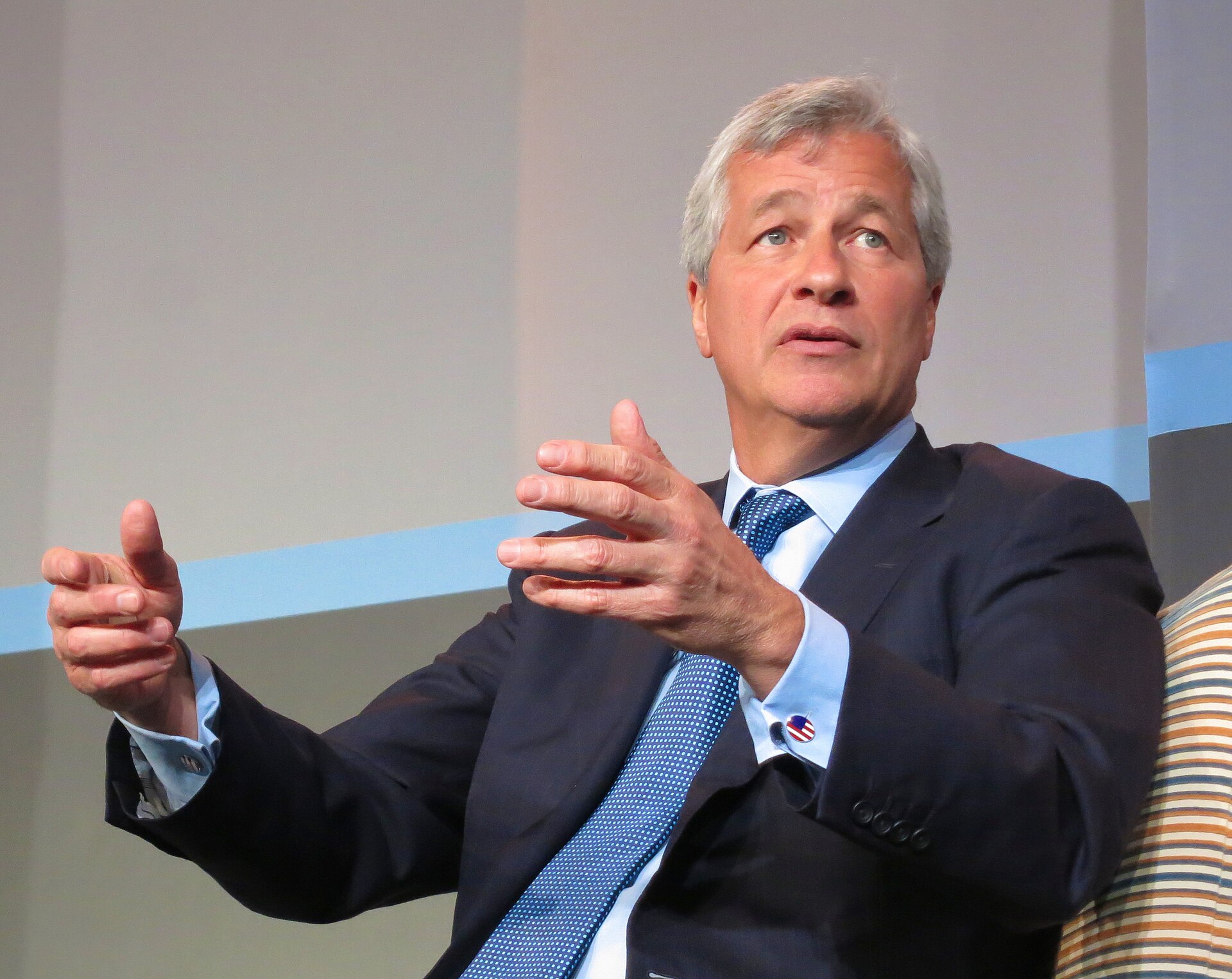
Jamie Dimon’s interest in finance began during his childhood in Queens, where his father, Theodore Dimon, worked as a stockbroker and encouraged his sons to study businesses and markets. Dimon’s early life combined that family influence with intensive reading, a strong academic record and early work experiences that led him to American Express shortly after Harvard Business School.
For a broader account of his later rise through Bank One and JPMorgan Chase, see the Newsr profile of Jamie Dimon. This article focuses on the family, education and career beginnings that preceded his most prominent leadership roles.
A New York childhood shaped by finance
Dimon was born in New York City on March 13, 1956, and grew up in the Jackson Heights neighborhood of Queens, according to the biographical record summarized by Wikipedia’s Jamie Dimon biography. He was one of three sons of Theodore and Themis Dimon. The available sources identify the family as having Greek ancestry and name his brothers as Peter and Ted, his fraternal twin.
The family’s financial background reached back a generation. Dimon’s paternal grandfather, Panos Papademetriou, was a Greek immigrant whose surname later became Dimon. In a CNBC interview, Dimon said his grandfather arrived in the United States without money, initially worked as a busboy and later rose to become a vice president at Atlantic Bank of New York before moving into stockbroking at Shearson, Hammill & Co.
Both Theodore Dimon and his father worked as stockbrokers at Shearson, according to the supplied biographical sources. That made finance a visible part of family life rather than an abstract career option. CNBC reported that Dimon learned about the brokerage business “across the kitchen table,” drawing on a family environment where stocks, work and professional judgment were regular subjects of conversation.
The public record provides substantially more detail about Dimon’s father and grandfather than about his mother. Sources identify his mother as Themis, née Kalos, but do not establish a detailed public account of her occupation or personal life. That distinction matters: the evidence supports describing Dimon’s early financial influence as coming especially from his father and paternal grandfather, not from assuming that both parents played identical professional roles.
What Jamie Dimon learned from his father
In a 2026 interview described by Fortune, Dimon recalled that his father created investment exercises for him. Theodore would name an industry, such as restaurants, and ask his son to review its history, study an annual report and decide what he would pay for the company’s stock. Dimon described the exercise as “brutally hard,” emphasizing that the point was not simply to choose a stock but to understand the reasons behind a valuation.
Fortune reported that Theodore encouraged all three sons to learn about markets, although Jamie was the one who became especially interested. At 14, Dimon bought his first stock with guidance from his father. That account places his first direct investment in 1970, when he was still a teenager. It also helps explain why later descriptions of Dimon’s career often begin with his childhood: his exposure was practical and analytical, not merely the result of growing up around financial professionals.
Reading became another part of that early formation. Dimon has said that, while in high school, he read works on investing and finance, including Security Analysis by Benjamin Graham and David Dodd. He also described reading psychology, economics and accounting materials, as well as the works of Sigmund Freud. CNBC reported that Dimon credited his grandfather with being a prolific reader and said the older man’s habits influenced him.
Those recollections are personal accounts rather than independently measured proof that a particular book or exercise determined Dimon’s career. They do, however, provide direct evidence of how Dimon himself explains the origins of his interest in business: repeated practice evaluating companies, family conversations about markets and a habit of reading beyond school assignments.
School years and the first steps toward Wall Street
Dimon attended the Browning School, a private boys’ preparatory school on Manhattan’s Upper East Side. He then studied economics and psychology at Tufts University, graduating in 1978 with a Bachelor of Arts degree, summa cum laude, according to the supplied biographical record.
His first documented professional connection to finance came while he was at Tufts. Wikipedia’s account says Dimon wrote a paper about mergers involving Shearson. His mother sent the paper to Sanford “Sandy” Weill, a senior figure in the financial industry, who hired Dimon during a summer break to work on budgets. The episode connected Dimon’s academic interests with the executive who would later become his most important early mentor.
After Tufts, Dimon worked as a management consultant at the Management Analysis Center in Boston from 1978 to 1980. He then entered Harvard Business School. During the summer between his first and second years there, he worked at Goldman Sachs. Dimon graduated from Harvard in 1982 with an MBA and received Baker Scholar honors, awarded to students who finish in the top 5% of the class, according to the same biographical source.
Why American Express became the decisive beginning
After earning his MBA, Dimon had offers from Goldman Sachs, Morgan Stanley and Lehman Brothers, but chose to work with Weill as an assistant at American Express. Fortune reported that Weill could not match the investment banks’ compensation but persuaded Dimon by promising that the work would be engaging. Dimon’s father was also an executive vice president at American Express at the time, according to the supplied biographical account.
Dimon joined Weill in 1982. In a 1984 Fortune profile, the 28-year-old Dimon described his immediate goal as learning and withholding his opinions until he could add value. That approach framed the role as an apprenticeship: he was close to a senior executive, exposed to major decisions and still early enough in his career to concentrate on absorbing how financial companies operated.
When Weill left American Express in 1985, Dimon followed him. In 1986, they took over Commercial Credit, a consumer-finance company, and Dimon became its chief financial officer at age 30. That promotion marked the transition from a promising assistant and analyst into an operating executive with responsibility for a company’s finances. Later positions at Travelers, Smith Barney and Citigroup built on that foundation, but they belong to a subsequent chapter.
Dimon’s childhood and parents therefore explain part of his career without explaining all of it. His father and grandfather introduced him to markets; his own reading and schoolwork deepened the interest; and the early connection to Weill gave him an unusually consequential entry into financial management. By the time he reached Commercial Credit, the pattern was clear: family exposure had opened the door, but education, disciplined study and hands-on work shaped the career that followed.
For context on how those early experiences eventually connected to his leadership at JPMorgan Chase, read Newsr’s full Jamie Dimon biography.
This profile separates documented family and education details from Dimon's own recollections about how his father and grandfather influenced his interest in finance.
Sources and methodology
- Jamie Dimon - Wikipedia: https://en.wikipedia.org/wiki/Jamie_Dimon
- JPMorgan CEO Jamie Dimon says his father taught him to invest with a 'brutally hard' childhood game - Fortune: https://fortune.com/2026/07/29/jamie-dimon-says-his-stockbroker-father-taught-him-to-invest-with-a-brutally-hard-childhood-game/
- JPMorgan CEO Jamie Dimon: How my grandfather inspired my career - CNBC: https://www.cnbc.com/2020/12/01/jpmorgan-ceo-jamie-dimon-how-my-grandfather-inspired-my-career.html