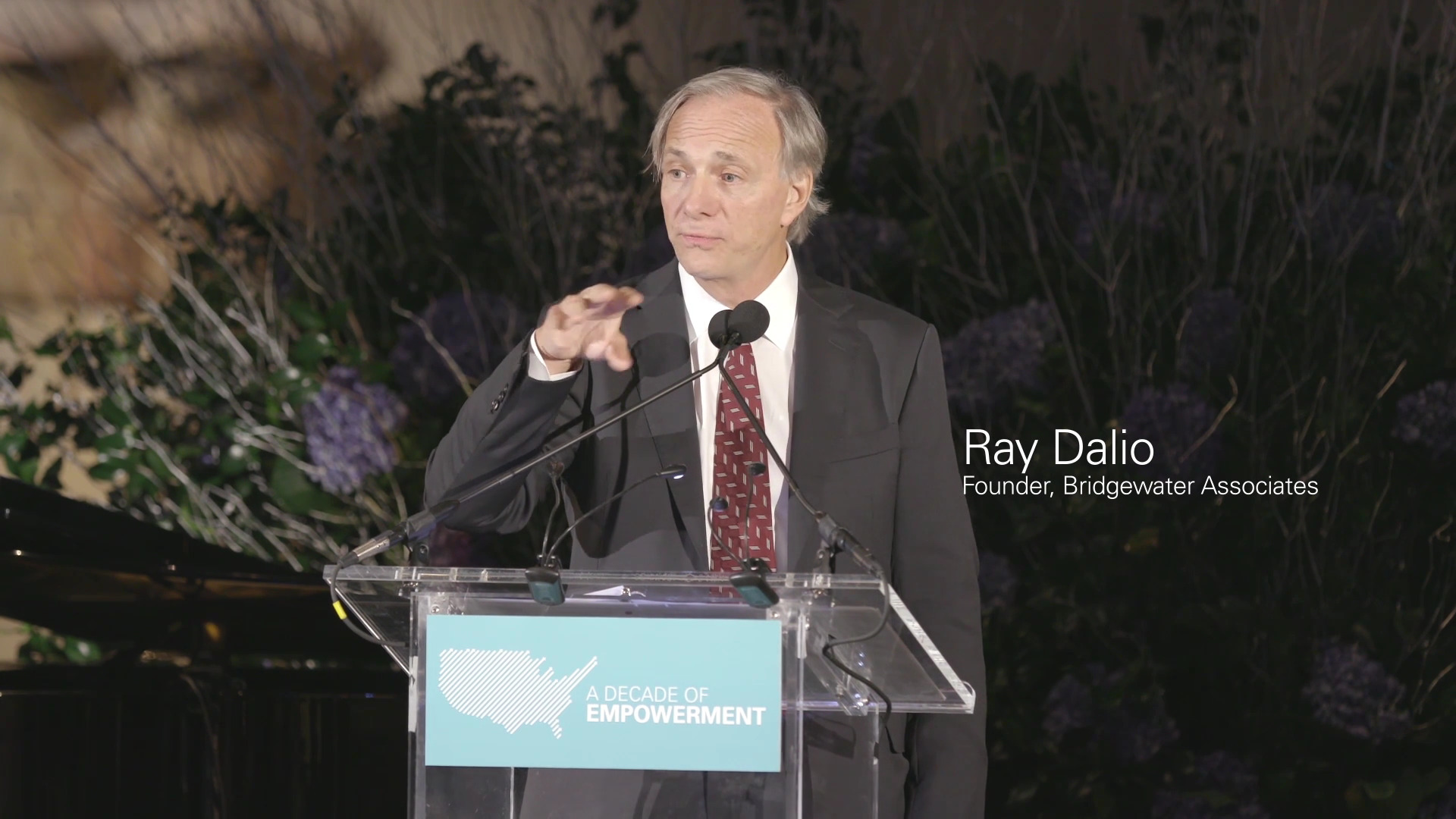
Ray Dalio is an American investor, author and founder of Bridgewater Associates, the hedge-fund firm he started in 1975. He became known for applying global economic research, systematic decision-making and portfolio diversification to investing. In later years, Dalio has focused less on running Bridgewater and more on explaining his ideas about markets, leadership and economic cycles.
Ray Dalio at a glance
- Full name
- Raymond Thomas Dalio
- Born
- August 8, 1949, according to the biographical record cited by Wikipedia; the Academy of Achievement lists August 1, 1949.
- Known for
- Founding Bridgewater Associates, the “All Weather” portfolio and writing about investment and management principles
- Education
- Long Island University, Post, and Harvard Business School
- Current focus
- Mentoring and sharing investment and decision-making principles, according to Bridgewater
Why is Ray Dalio well known?
Dalio is best known for building Bridgewater Associates into one of the world’s largest hedge-fund firms. He founded the company in New York City in 1975, initially operating from a two-bedroom apartment. Bridgewater began as a wealth-advisory and research business before expanding into institutional investment management.
The firm’s early work included commentary on global markets and commodities. Its research publication, Bridgewater Daily Observations, helped attract institutional clients. Bridgewater says the World Bank became its first institutional fund-management client in 1985, with a $5 million account. The firm later became associated with large-scale global macro investing, a style that examines interest rates, currencies, inflation, trade, debt and other forces that affect economies and markets.
Dalio also became prominent for his writing. His 2017 book, Principles: Life & Work, presents his approach to decision-making, management and organizational culture. His work on the rise and decline of countries, debt and economic power has also shaped his public profile. His public explanations often use long historical comparisons rather than focusing only on short-term market movements.
How did Ray Dalio start investing?
Dalio grew up in Queens and later moved with his family to Manhasset on Long Island. His father was a jazz musician and his mother was a homemaker, according to Bridgewater’s biography and the Academy of Achievement. As a child, Dalio worked as a golf caddie. He became interested in stocks after hearing investors discuss the market on the golf course.
The Academy of Achievement says Dalio used $300 saved from caddying to buy shares of Northeast Airlines when he was 12. The company later became the subject of a merger effort, and the investment increased in value. Dalio has described the episode as an early lesson in both luck and the danger of relying on a simplistic reason to buy a security.
His interest later broadened from stocks to commodity futures. After college, he worked on the floor of the New York Stock Exchange and held positions at Dominick & Dominick and Shearson Hayden Stone, according to the biographical accounts. His early experience with commodities, currencies and interest rates helped shape the global macro perspective that became central to Bridgewater.
What is Bridgewater Associates?
Bridgewater Associates is the investment firm Dalio founded in 1975. Its business developed from advising clients on financial exposures and publishing research into managing money for institutional investors. Bridgewater’s official biography describes the firm as growing from Dalio’s apartment into a global institution over 47 years.
Two strategies are especially associated with Dalio. In 1991, he launched Pure Alpha, Bridgewater’s flagship strategy, which sought returns from investment views across global markets. In 1996, he launched All Weather, a portfolio approach designed to balance exposure across different economic environments. The latter helped popularize the idea of risk parity, which emphasizes balancing risk rather than simply dividing capital equally among asset classes.
Bridgewater also became known for an internal culture that encouraged open disagreement and detailed review of decisions. Forbes describes the firm’s approach as “radical transparency,” including the airing of disagreements and recording of meetings. That description is an attributed characterization, not a universal assessment of the firm’s culture.
What are Ray Dalio’s investment principles?
Dalio’s framework begins with the idea that economic and market events result from cause-and-effect relationships. He argues that studying repeated patterns can help investors develop rules for responding to them. His approach places particular emphasis on identifying mistakes, testing assumptions and making decisions based on evidence rather than personal certainty.
A related idea is the value of “believability-weighted” decision-making: people should consider the quality of a person’s relevant track record when evaluating an opinion. Dalio has also written about the importance of meaningful disagreement, clear accountability and systems that allow organizations to learn from errors. These ideas were developed in the context of Bridgewater, but his books and public talks present them as broader tools for work and life.
His portfolio thinking is similarly focused on resilience. Instead of assuming one economic outcome, the All Weather concept seeks to prepare for different combinations of growth, inflation and other conditions. The approach is associated with diversification across asset classes and with managing risk deliberately. It is a framework, not a guarantee of positive returns, and the suitability of any investment strategy depends on an investor’s circumstances.
When did Ray Dalio leave Bridgewater’s leadership?
Dalio no longer runs Bridgewater as its chief executive or chief investment officer. Bridgewater says he stepped down as CEO in 2017, as CIO in summer 2020 and as chairman at the end of 2021. The company says he now concentrates on mentoring people at Bridgewater and elsewhere and on passing along the principles he developed during his career.
Forbes gives a somewhat different account of the later transition, saying Dalio retired as co-CIO in 2022 and sold his full stake in the firm by 2025. Because the supplied accounts use different dates and descriptions for the transition, the safest conclusion is that Dalio’s operational leadership and ownership at Bridgewater were transferred over several years rather than ending in a single event.
How wealthy is Ray Dalio?
Net-worth figures for billionaires are estimates and change with asset prices, private-company valuations and methodology. Forbes listed Dalio’s real-time net worth at $15.4 billion on August 31, 2026, ranking him No. 202 in the world. A separate Wikipedia entry cited a June 2026 estimate of $21.5 billion and a different ranking. Those figures should not be treated as audited financial statements or as an exact measure of his wealth.
Forbes also reported that Bridgewater managed $92 billion. The figure describes assets managed by the firm, not Dalio’s personal fortune. Dalio’s wealth is generally associated with his long career in hedge-fund investing and his ownership and compensation history at Bridgewater.
What books has Ray Dalio written?
Dalio’s best-known book is Principles: Life & Work, published in 2017. It combines personal biography with guidance on decision-making, management and organizational design. He also wrote The Changing World Order, which examines how leading countries rise and decline through recurring economic, financial and geopolitical patterns.
His earlier educational work includes How the Economic Machine Works, an explanation of debt cycles and the interactions among productivity, credit and spending. His public writing has continued into 2026 through articles and posts about economic conditions, national debt, global power and investment strategy. His views on these subjects are opinions and analytical frameworks, not settled forecasts.
What is known about Dalio’s philanthropy and personal life?
Forbes reports that Dalio has given more than $1 billion to philanthropic causes and that Dalio Philanthropies has supported microfinance and public education. The supplied sources do not provide a complete accounting of his charitable giving, so individual totals and program outcomes should be treated as reported estimates rather than independently verified figures.
Dalio has publicly discussed Transcendental Meditation, which he began practicing in 1969 and credits with helping his concentration and creativity. Public biographical sources identify him as married and the father of four sons. This profile does not add private details about family members beyond information already made public in the supplied sources.
Why does Ray Dalio remain influential?
Dalio’s influence comes from the combination of a major investment firm, a distinctive management philosophy and a willingness to explain complex economic subjects to a broad audience. His record at Bridgewater made him a significant figure in institutional investing, while his books turned ideas about principles, feedback and economic cycles into material used by readers outside finance.
His public warnings about debt, currency risk and changes in the global balance of power continue to attract attention. They are best understood as Dalio’s interpretations of historical and current conditions. The enduring, verifiable part of his profile is simpler: he founded Bridgewater, helped develop its global macro approach, wrote extensively about principles and gradually handed the firm to a new generation of leaders.
Source note: This profile separates biographical facts from attributed estimates and notes where the supplied sources conflict, particularly on Dalio’s birth date, wealth and timeline for leaving Bridgewater leadership.
Ray Dalio's public story is not only that of a billionaire hedge-fund founder. It is also the story of an investor who turned repeated market mistakes, historical study and organizational experiments into a teachable framework for making decisions under uncertainty. The central facts are well established: he founded Bridgewater in 1975, developed a global macro investing approach, published widely read books and transferred operational control of the firm over time. Wealth figures and some personal biographical details remain estimates or inconsistent across sources.
Sources and methodology
- Ray Dalio: https://en.wikipedia.org/wiki/Ray_Dalio
- Our Founder: https://www.bridgewater.com/our-founder
- Ray Dalio: https://www.forbes.com/profile/ray-dalio/
- Ray Dalio: https://achievement.org/achiever/ray-dalio/