

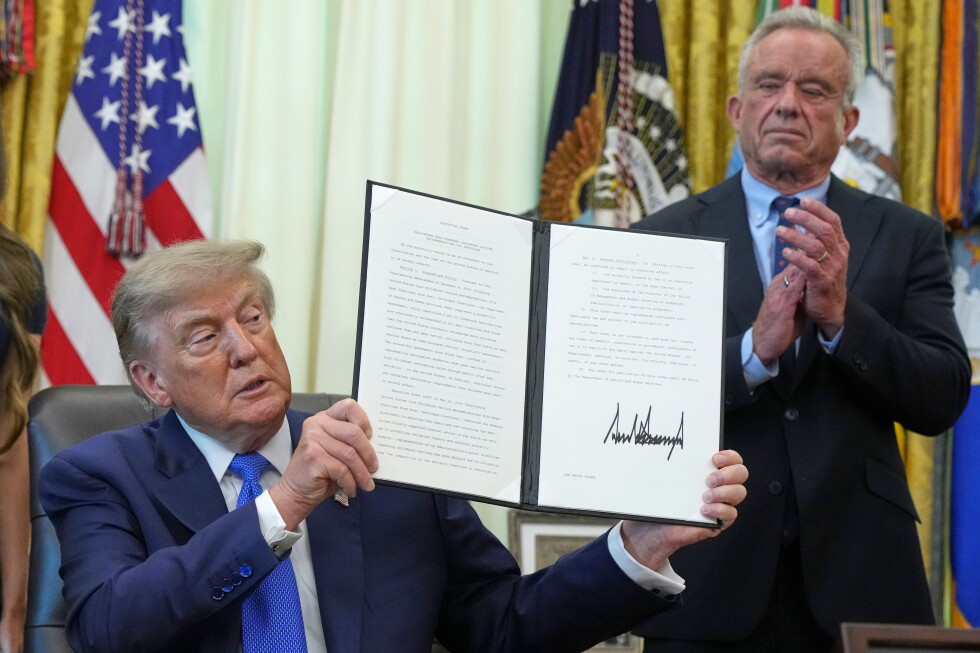
The short answer: Donald Trump’s 2026 executive order has created a new federal fight over childhood vaccine policy, but the available evidence does not show what specific schedule changes will occur. The Associated Press reported on August 11, 2026, that Trump signed the order while making false claims about vaccines and autism. The Autistic Self Advocacy Network opposed the action the day before, saying the administration had offered no scientific evidence for the claimed link.
What is verified—and what is not
The supplied reporting establishes three points. Trump signed an executive order urging changes to child vaccine policy. He and other administration officials repeated a claim connecting childhood vaccines with autism. AP’s fact-check characterized those claims as false.
That is different from proving that a new vaccination schedule has already been adopted. The evidence pack does not include the order’s text, an agency implementation memo, a revised schedule, a federal funding decision or a court filing. It also does not identify which vaccines, age groups or clinical recommendations would be affected.
That missing detail matters. A presidential directive can request reviews, instruct agencies to develop recommendations or set a policy direction, but the practical effect depends on the document’s language and the actions that follow. In this case, the supplied sources do not establish the mechanism, timing or legal scope of the order.
The autism claim is the central evidence problem
ASAN said the administration offered no scientific evidence supporting a vaccine-autism connection and described the claim as misinformation. Its statement also said the original claim arose from a fraudulent study that was later retracted, while subsequent research found vaccines safe and autism related to genetics.
Those statements are important context, but the evidence pack does not provide the underlying studies, an official evidence review or a clinical guideline. It gives no study populations, sample sizes, effect estimates or absolute risks. Neither AP’s supplied article text nor ASAN’s statement is a peer-reviewed research paper.
The responsible conclusion is therefore limited: the vaccine-autism assertion reported in connection with the order is not supported by the evidence described by the two sources. The supplied material does not justify presenting a new medical finding, estimating a health risk or advising individuals to change vaccination decisions.
Who could be affected by the policy dispute
Parents and caregivers could face uncertainty if federal agencies propose changes to the child vaccine schedule or issue conflicting public messages. Pediatric practices, schools and public-health departments could also have to interpret new federal guidance if it is eventually released. The direct impact, however, cannot yet be measured from the available record because no revised schedule, coverage data or implementation plan is supplied.
Autistic people and their families are another affected group, according to ASAN. The organization argued that repeating the vaccine claim stigmatizes autistic people and diverts public attention from access to health care, Medicaid, home- and community-based services, housing, education, employment and communication supports. Those are the priorities ASAN identified; the sources do not quantify unmet need or show how federal resources will be redistributed.
Known, uncertain and next steps
Known: AP reported the signing and described the autism claims as false. ASAN publicly opposed the order and said no scientific evidence was offered to support the claimed link.
Uncertain: The full text of the executive order, the responsible agencies, the proposed vaccine changes, the timetable and any effect on clinical practice are not included in the supplied evidence. It is also unclear whether the order will produce a recommendation, a regulatory change, litigation or no operational change.
Next: Readers should look for the complete order and follow-up agency documents. The most useful documents will specify whether officials are conducting a review, who must complete it, when findings are due and whether any recommendation differs from existing clinical guidance. Until those records appear, claims about concrete schedule changes remain premature.
For health decisions, the evidence provided here is not a substitute for guidance from a qualified clinician or public-health authority. This article does not diagnose, prescribe or recommend changing a child’s vaccination plan.
The evidence supports a policy controversy, not a completed change to children’s vaccination schedules. AP independently reported the signing and identified the autism claims as false, while ASAN documented opposition from an autistic-led advocacy organization. The record supplied here lacks the executive-order text, clinical studies, official guidance and implementation documents needed to assess legal scope, medical implications or measurable health effects. The next responsible reporting step is to examine those primary documents rather than infer consequences from the announcement alone.
Sources and methodology
- Trump makes false claims as he signs EO urging child vaccine changes - https://apnews.com/article/fact-check-trump-vaccines-schedule-executive-order-autism-287503e351b38ec01ac7377eadbc22c4
- ASAN Opposes Executive Order Targeting Vaccines - https://autisticadvocacy.org/2026/08/asan-opposes-executive-order-targeting-vaccines