
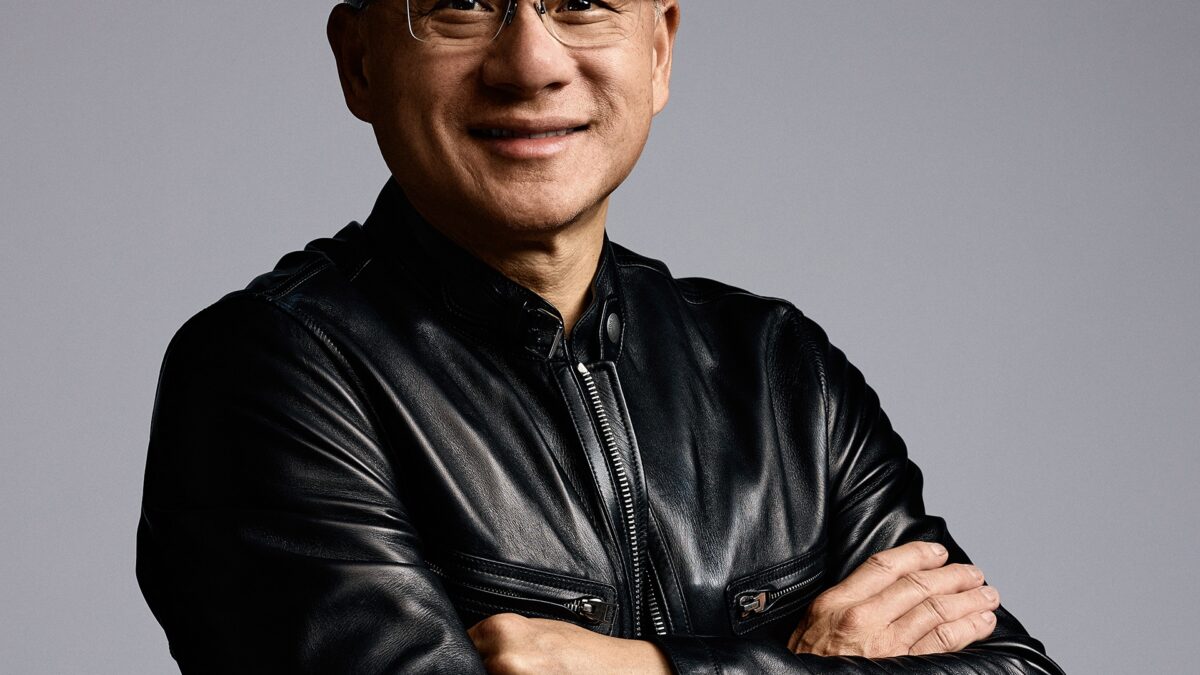
Jensen Huang’s career and net worth are inseparable from Nvidia. He co-founded the semiconductor company in 1993, became its president and CEO, and has held those positions continuously, according to Forbes’ Jensen Huang profile. As of August 23, 2026, Forbes listed his real-time net worth at $185.5 billion, ranking him No. 8 in the world. That figure is an estimate, not a cash balance: it moves with Nvidia’s stock price and with changes in the value of Huang’s disclosed holdings and other assets.
For readers researching Jensen Huang’s broader profile and background, the key business point is straightforward: his wealth was created primarily through long-term ownership of Nvidia rather than through a portfolio of publicly documented companies. Nvidia’s rise from a graphics-chip start-up to a major supplier of artificial-intelligence infrastructure transformed the value of Huang’s stake.
A career built around one company
Huang launched Nvidia at age 30 after earning an engineering degree from Oregon State University and a master’s degree from Stanford University. The company initially focused on graphics processing units, or GPUs, for computer games and 3D graphics. That early market gave Nvidia a technical and commercial base, but it was not the only direction the company explored.
Over time, Nvidia expanded beyond gaming into high-performance computing and artificial intelligence. CNBC reported in 2024 that the company had also entered areas including cloud gaming subscriptions, metaverse applications and cryptocurrency-mining chips. Those were Nvidia business lines or markets, not separate companies personally owned by Huang. The distinction matters: available sources identify Nvidia as Huang’s central business venture, while they do not establish a broad private-company empire under his name.
Huang’s role has combined engineering leadership, product strategy and sales. CNBC described him as Nvidia’s principal salesperson and public advocate for GPU-based computing. That responsibility became especially important as large technology companies increased spending on AI systems. Nvidia’s chips, software tools and related infrastructure placed the company at the center of that investment cycle.
How Nvidia became the source of Huang’s fortune
Huang’s wealth largely reflects his equity position in Nvidia. Forbes said in its August 2026 profile that he owned approximately 3% of the company. The exact value of that stake changes throughout the trading day, so a net worth estimate from one publication or date should not be treated as a permanent figure.
The effect of Nvidia’s share price can be seen in earlier reporting. In May 2024, CNBC calculated that Huang held about 86.76 million Nvidia shares, representing more than 3.5% of the company at that time. CNBC said the value of his holdings had risen to more than $90 billion after a major stock-market rally. The report also noted that the value of his stake had been about $3 billion five years earlier.
Those figures illustrate why Huang’s net worth rose so quickly during the AI boom. The company’s market valuation increased sharply as cloud providers and other technology companies invested heavily in AI computing. Huang’s fortune increased because he retained a substantial ownership position in the company he founded, not because Nvidia’s annual salary alone could account for the change.
Why estimates differ
Published net worth numbers can vary widely because they use different stock prices, ownership records, asset assumptions and publication dates. Forbes’ figure of $185.5 billion is specifically identified as a real-time estimate as of August 23, 2026. It should therefore be separated from earlier figures rather than averaged with them.
For example, a 2025 Business Insider report republished through Yahoo Finance placed Huang’s estimated wealth at $147 billion at a particular market close. CNBC’s 2024 estimate was lower still because Nvidia’s share price and Huang’s holdings were worth less at that point. These are not necessarily contradictions. They are snapshots taken at different times in a volatile public market.
Ownership dilution is another reason Huang is not automatically the world’s wealthiest person even when Nvidia’s market value ranks among the largest. Business Insider reported that Huang held 12.8% before Nvidia’s 1999 initial public offering, compared with less than 4% in the period discussed in its 2025 report. The decline reflected stock issuance, employee equity compensation and Huang’s own share sales. A founder can lead an extraordinarily valuable company while owning a much smaller percentage of it than at its formation.
Nvidia’s business expansion under Huang
Nvidia’s business model evolved from selling graphics processors for gaming into providing a broader computing platform. The company’s GPUs became important for high-performance computing and machine-learning workloads, while its software and systems helped customers deploy those processors at scale.
That expansion is central to understanding Huang’s career. He did not simply benefit from a single successful product cycle; he remained in charge as Nvidia moved into new technical markets. The company’s long-term investments in AI software and tools positioned it to benefit when generative AI became a mainstream commercial priority after the release of ChatGPT in late 2022, according to CNBC.
Still, Nvidia’s success does not eliminate business risk. Huang’s personal wealth is concentrated in one publicly traded company, and the value of that concentration can fall if demand, competition, regulation, supply conditions or investor expectations change. A high net worth estimate is therefore best understood as an equity valuation, not readily spendable money.
Documented ventures beyond Nvidia
The supplied reporting documents Huang’s education-related philanthropy, including a $30 million gift to Stanford for an engineering center and a $50 million gift to Oregon State University in 2022 for a research center bearing his name. These contributions show a significant connection to engineering education, but they are philanthropic commitments rather than evidence of separate operating companies.
Based on the available sources, the defensible summary is that Huang’s business career is dominated by one enduring venture: Nvidia. His influence comes from founding the company, retaining meaningful equity and guiding its expansion from gaming graphics into AI and high-performance computing. His estimated net worth follows the market value of that position, which is why any current figure must include its date and source.
For a concise overview of Jensen Huang’s career and personal profile, readers can consult the related Newsr coverage. This article’s narrower conclusion remains financial and commercial: Nvidia ownership, rather than a confirmed collection of private businesses, is the main explanation for Huang’s reported wealth.
Jensen Huang’s career is a case study in concentrated founder wealth: one company, sustained leadership and an ownership stake whose value rose with Nvidia’s expansion into AI computing. The net worth estimates are substantial but fluid, reflecting public-market valuation rather than cash on hand.
Sources and methodology
- Jensen Huang — Forbes profile: https://www.forbes.com/profile/jensen-huang/
- Jensen Huang — Wikipedia: https://en.wikipedia.org/wiki/Jensen_Huang
- Nvidia CEO Jensen Huang's net worth swells by $87 billion in 5 years — CNBC: https://www.cnbc.com/2024/05/24/nvidia-ceo-jensen-huangs-net-worth-swells-by-87-billion-in-5-years.html
- Nvidia is the world's most valuable company. Why does CEO Jensen Huang barely make the list of the 10 wealthiest people? — Business Insider: https://www.businessinsider.com/nvidia-stock-jensen-huang-wealth-musk-buffett-ai-tech-compensation-2025-9