
The 2026 Nara Organics powdered infant formula recall illustrates a practical limit of food-safety alerts: announcing a recall is not the same as protecting every household that may still have the product. Food Safety News reported that Nara Organics recalled all lots in June 2026 after the FDA investigated four confirmed cases of infant botulism among infants who had consumed the formula. The supplied evidence does not show how many units were distributed, how many remained in homes or how many consumers were reached.
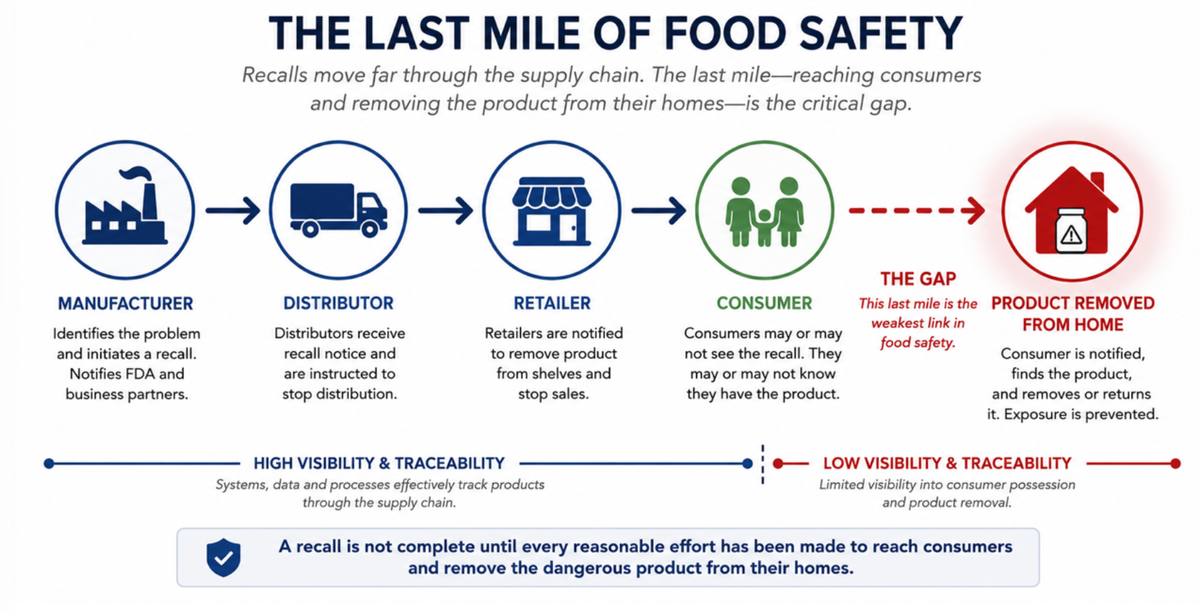
That missing last-mile information is the central consequence for families, retailers, regulators and the manufacturer. A product can leave store shelves while still sitting in a pantry, a childcare setting or a household that never saw the notice. For infant formula, the affected population is especially consequential because the reported cases involved infants, but the available material does not provide a denominator, illness-rate calculation, clinical outcomes or an independent epidemiological analysis.

The household problem: recognition before action
Consumers need enough information to determine whether a product in their possession is included in a recall. The report describes several ways that process can fail: a parent may be unable to find the relevant product code, may have discarded the container, or may learn about the recall only after the product was consumed. Those examples explain the mechanism of household risk, but they do not measure how often each barrier occurred in the Nara Organics event.
That distinction matters. Without the recalled codes, distribution data and recovery figures in the supplied evidence, it is not possible to calculate the share of potentially affected households that received a useful warning. It is also not possible to conclude from the four confirmed cases alone how many consumers were exposed or whether the recall prevented additional illness.
What manufacturers and retailers must absorb
For Nara Organics, the immediate obligation described in the evidence was a recall covering all lots of the powdered formula. The business cost is not limited to taking inventory off shelves. It can include identifying where products moved, communicating with distributors and retailers, handling returned or discarded units, and answering consumers who no longer have packaging that would identify a lot.
Retailers face a parallel operational burden. Store-level removal can address inventory that is still in commerce, but it cannot by itself identify products already purchased. The available sources do not provide a recovery rate, a financial estimate or a comparison between the cost of broader outreach and the cost of narrower notification. Those figures should not be inferred from the existence of the recall.
Why traceability is the regulatory lever
The FDA’s FSMA final rule establishes additional recordkeeping requirements for people who manufacture, process, pack or hold foods on the Food Traceability List. The rule centers on Key Data Elements tied to specific Critical Tracking Events and requires covered entities to provide information to the FDA within 24 hours or another agreed timeframe. The agency says the system is intended to support faster identification and removal of potentially contaminated food.
That mechanism addresses the supply-chain side of the problem: determining where a product came from, where it went and which transactions matter. It does not, by itself, prove that every consumer can be contacted after purchase. The FDA held a public meeting on June 15, 2026, focused in part on lot-level tracking and compliance flexibilities, and released related discussion and readiness materials. Those steps show that implementation questions remain active rather than settled.
Where authority and responsibility overlap
Produce Grower describes food recalls as often voluntary and reports that an agency can issue a public alert or seek a court-ordered recall if a company declines to act. That account is useful for understanding the regulatory choices, but it is not a case-specific finding about Nara Organics. The supplied material does not establish whether any compulsory action was considered or used in this recall.
The broader stakeholder map is therefore clear even where the measurements are not. Families need an understandable warning and a reliable way to identify the product. Manufacturers need records and outreach capable of following products beyond the warehouse. Retailers need effective removal procedures. Regulators need timely, lot-level information and a way to assess whether the response reached consumers rather than merely generating an announcement.
What remains unknown and what comes next
The strongest unanswered questions are measurable: how many units entered distribution, how many were recovered, how many households were notified, and whether any additional cases were confirmed after the June 2026 recall. None of those figures appears in the supplied evidence.
Until those data are published, the responsible conclusion is limited. The Nara Organics case supports the importance of the recall’s household endpoint, but it does not establish the recall’s effectiveness. The next milestone to watch is the FDA’s continuing work on lot-level traceability after the June 15, 2026, public meeting, especially any formal implementation decision or measurable reporting on how quickly covered firms can produce the records required by the rule.
The important story is not simply that a powdered infant formula recall was announced in 2026. It is that consumer protection has two separate stages: removing product from commerce and reaching households that already bought it. The supplied evidence verifies a Nara Organics recall and four confirmed infant botulism cases investigated by the FDA, but it does not provide distribution, recovery or notification totals. FDA traceability requirements may improve the speed and precision of supply-chain records, yet the effectiveness of the final household step remains unmeasured here. Further lot-level implementation decisions and recall-performance data are the signals that can turn a warning into an assessable protection outcome.
Sources and methodology
- The last mile of a food safety recall: It is not complete until consumers are protected - foodsafetynews.com - https://www.foodsafetynews.com/2026/08/the-last-mile-of-a-food-safety-recall-it-is-not-complete-until-consumers-are-protected
- FSMA Final Rule on Requirements for Additional Traceability Records - FDA - https://www.fda.gov/food/food-safety-modernization-act-fsma/fsma-final-rule-requirements-additional-traceability-records-certain-foods
- Understanding food recalls in the CEA industry - Produce Grower - - https://www.producegrower.com/article/food-recalls-consumer-safety-controlled-environment-agriculture
- Food Policy Insider: August 2026 - Consumers Union - https://advocacy.consumerreports.org/research/food-policy-insider-august-2026