

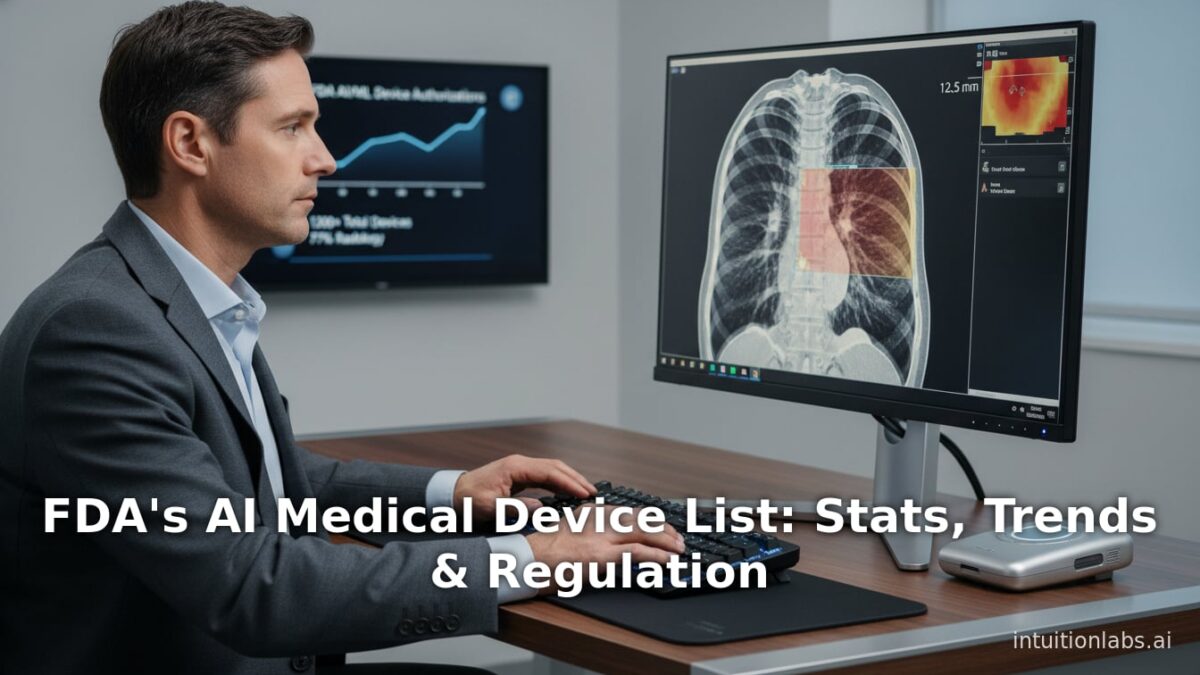
The practical issue is not simply that the FDA’s AI-enabled medical-device list is approaching 1,500 entries. It is that a marketing authorization tells hospitals and patients a device met applicable premarket requirements for its intended use, while leaving a broader question open: how reliably will it work across different people, hospitals and clinical routines?
That distinction matters as healthcare organizations decide whether an AI tool is worth the cost and operational disruption. The evidence supplied here supports a fast-growing market, not a conclusion that the devices are interchangeable or uniformly validated.

A rapidly expanding list is not a universal performance score
An analysis updated in March 2026 reported 1,451 FDA-authorized AI/ML devices through the end of 2025, including 295 cleared during 2025. The same analysis said radiology represented approximately 76% of the listings, or 1,104 devices, while cardiology accounted for about 9%.
Those figures describe the composition of a regulatory tracker. They do not measure how many patients benefited, how often a tool changed a clinician’s decision or whether performance held steady outside the setting used for evaluation. The FDA itself says its AI-enabled device list is not comprehensive. It identifies devices primarily through AI-related terms in marketing-authorization summaries or device classifications, and provides links to database entries with releasable safety and effectiveness information.
The FDA also says the devices on the list met applicable premarket requirements, including a focused review of safety and effectiveness for the intended use and technological characteristics. That is meaningful evidence of regulatory review. It is not the same as a single, standardized threshold for broad clinical usefulness.
Who faces the consequences of uneven evidence?
Providers face the immediate implementation burden. An AI device may require workflow changes, staff training, integration with existing systems and a process for handling outputs that appear inconsistent with clinical judgment. Those costs are difficult to compare from a device count alone. A tool cleared for a narrow task may still demand substantial oversight once used in a busy hospital.
Patients face a different risk: a device can be authorized for a defined use without its performance being equally established for every population or care environment. The 2025 JAMA Network Open study supplied with this report specifically examined the generalizability of FDA-approved AI-enabled medical devices for clinical use. The evidence pack does not provide enough of the study’s results to state a numerical conclusion about demographic or site-level performance, so that question remains open here.
Developers and regulators also face a moving-target problem. Software can change after launch, and the FDA says it is exploring ways to identify and tag devices that incorporate foundation models, including large language models and multimodal architectures. That effort could make it easier for providers and patients to recognize when more complex AI functionality is present.
The measurable trade-off is speed versus visibility
The secondary tracker analysis says nearly all cleared AI devices entered through the 510(k) pathway, which relies on substantial equivalence rather than the most expensive forms of clinical testing. That pathway can support faster iteration and lower development barriers, but it also makes the quality and transparency of the submitted evidence especially important.
The same analysis reported that fewer than 2% of FDA-cleared AI/ML devices in one 2025 review were supported by randomized clinical trials. It also said many 510(k) summaries lacked details about study design, sample sizes and demographics. These findings do not prove that the remaining devices are unsafe or ineffective. They do show why a clearance total cannot substitute for device-by-device scrutiny.
For hospitals, the practical test is whether a vendor can explain the intended use, evaluation population, limitations, update process and monitoring plan. For patients, the relevant question is whether a clinician treats the output as supporting information or as an unexplained replacement for professional judgment.
What would close the evidence gap?
The next milestone is not another headline count. It is better lifecycle evidence: clearer study summaries, more information about training data and model characteristics, and follow-up showing whether performance remains dependable after deployment and software changes.
The FDA says its list is intended to improve transparency and help innovators understand regulatory expectations. Its planned work on foundation-model identification may improve disclosure, but the supplied evidence does not establish when a complete tagging system will be available or what information it will require.
Until those details improve, the responsible reading of the roughly 1,500-device market is straightforward: authorization confirms a regulatory pathway was met for a stated use, while general clinical reliability still has to be assessed in context.
The durable story is the gap between regulatory visibility and clinical generalizability. The FDA’s tracker shows that AI-enabled devices have become a substantial and expanding category, particularly in radiology, but the list is not a scorecard of real-world outcomes. A 2025 study focused on generalizability, while the supplied tracker analysis raised concerns about limited randomized-trial support and incomplete reporting in some summaries. Those points justify closer scrutiny without turning incomplete evidence into a finding of harm. Hospitals need context-specific validation and monitoring; patients need to know how AI informs care. The next meaningful progress will come from clearer disclosures and lifecycle evidence, not a higher authorization count.
Sources and methodology
- FDA Has Authorized 1,500 AI Medical Devices. The Evidence for Most of Them Is Still Catching Up. - The Clinical Trial Vanguard - https://pmc.ncbi.nlm.nih.gov/articles/PMC12044510
- Artificial Intelligence-Enabled Medical Devices - https://www.fda.gov/medical-devices/software-medical-device-samd/artificial-intelligence-enabled-medical-devices
- FDA's AI Medical Device List: Stats, Trends & Regulation - https://intuitionlabs.ai/articles/fda-ai-medical-device-tracker
- The Current State Of Over 1450 FDA-Approved, AI-Based ... - https://www.linkedin.com/pulse/current-state-over-1450-fda-approved-ai-based-medical-mesk-md-phd-3kojf