
Extreme heat affects people unevenly, and the safest decision depends on more than the afternoon high. Humidity can slow evaporation, forcing the body to work harder to maintain a normal temperature. Older adults, young children and people who are sick or overweight are identified by North Carolina’s ReadyNC as more likely to experience serious effects. People in cities may also face greater exposure because asphalt and concrete retain heat and release it slowly after sunset.
The available evidence supports a practical approach: treat official local alerts as the decision point, then adjust plans for the people, housing and cooling options involved. The sources do not verify a specific current heat watch for any North Carolina location, so readers should not interpret this article as a local alert.
Who faces the greatest exposure
ReadyNC identifies several groups with elevated vulnerability: older adults, young children and people who are sick or overweight. The page also points to overexposure and excessive exercise relative to a person’s age and physical condition as circumstances that can bring on heat-related illness.
That means a forecast can carry different consequences within the same household. A healthy adult with reliable indoor cooling may have more options than a young child, older relative or sick family member. The evidence does not support assigning a single universal threshold to every person, but it does support reducing unnecessary exposure when heat and humidity persist.
Why humidity and nighttime temperatures matter
High humidity slows water evaporation from the body. That mechanism matters because sweating is one way the body sheds heat; when evaporation becomes less effective, the body must work harder to stay within a safe temperature range.
Duration is another part of the decision. The National Weather Service’s HeatRisk system considers how unusual the heat is for the time of year, how long it will last and whether nighttime temperatures provide relief. Its categories range from little or no expected risk to extreme risk. HeatRisk is designed to provide additional guidance for decision-makers and heat-sensitive populations, but it is supplementary to official NWS heat watches, warnings and advisories.
What the July 2026 forecast showed
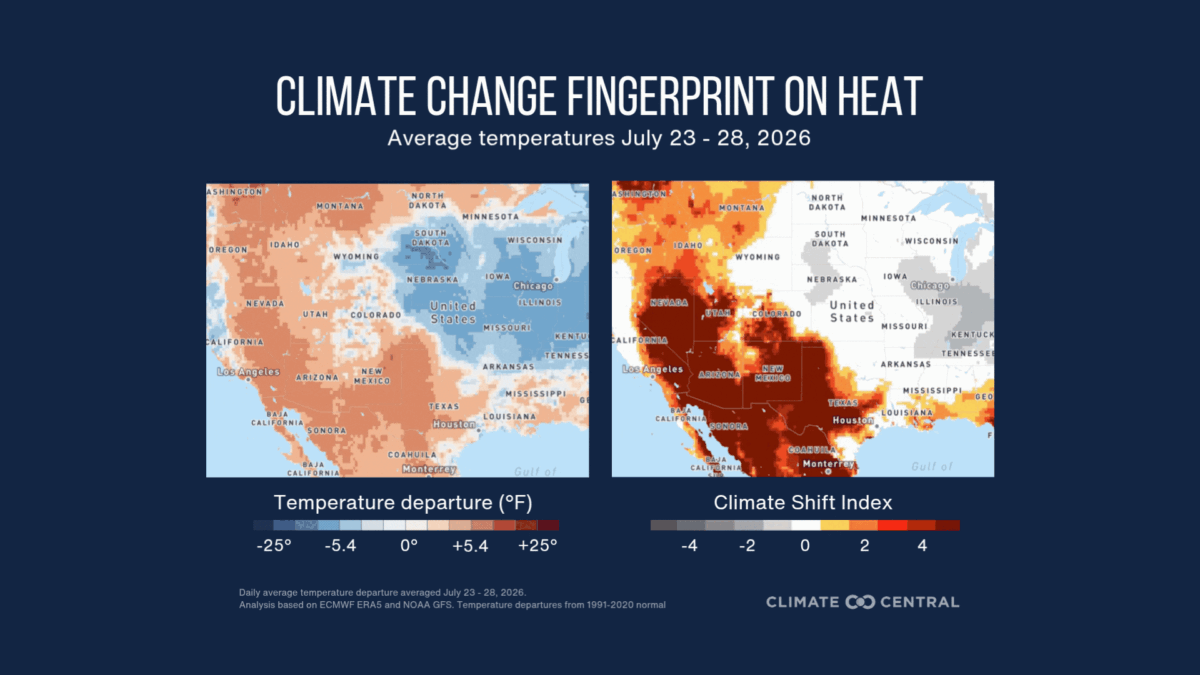
Climate Central reported on July 24, 2026, that human-caused climate change made the extreme heat in the event at least five times more likely according to its Climate Shift Index analysis. The report said more than two dozen states were forecast to experience temperatures above 100°F and that the event was expected to affect areas from the western United States through the Midwest and South.
Climate Central also reported that 60.2 million people were under heat alerts at the time of its analysis and that more than 101 million people across the western and southern United States were forecast to experience at least one day with a Climate Shift Index level of 5 or higher from July 23 through July 28. Those figures describe that forecast window, not a current alert count or a verified North Carolina impact total.
The household trade-offs
For households, the decision is often how to reduce heat exposure without assuming that every cooling measure works equally well in every home. ReadyNC recommends preparing an emergency kit and family communications plan, installing window air conditioners securely, checking duct insulation, weather-stripping doors and sills, and using drapes, shades, awnings or louvers to block sunlight.
The page says exterior awnings or louvers can lower heat entering a home by up to 80 percent. That is a manufacturer- or agency-provided guidance figure, not an independent measurement for every building. The evidence pack does not provide prices for air conditioners, electricity, insulation or other measures, so it cannot establish which option is cheapest.
Access is therefore part of the risk calculation. A plan that depends on air conditioning may not work for someone without reliable equipment or power. Readers should use official local information to identify the applicable alert level and consider the needs of people who are more vulnerable before heat becomes severe.
What to verify next
The next useful signal is a location-specific update from the National Weather Service: a local forecast, HeatRisk change or official heat watch, warning or advisory. That update can clarify whether the concern is brief daytime heat, a longer episode or a period without overnight relief.
Until that local information is available, the evidence supports preparation rather than a claim about a particular community’s current conditions. The central uncertainty is not whether extreme heat can be dangerous; the sources agree that it can. It is which locations, people and buildings face the greatest exposure in the next forecast period.
The evidence supports treating extreme heat as a layered household decision rather than a single temperature event. Humidity, duration and nighttime relief affect the physical burden, while age, illness, housing and cooling access shape who can respond. Climate Central's July 2026 analysis documents the scale and climate influence of one U.S. heat episode, but it does not establish current conditions in every state or city. ReadyNC provides preparation measures, including cooling and heat-blocking steps, while the NWS HeatRisk system adds impact-oriented context. The next reliable change in the assessment will come from a local forecast or official heat product.
Sources and methodology
- extreme heat watch - https://www.readync.gov/extreme-heat
- Climate change is intensifying an extreme and widespread ... - https://www.climatecentral.org/climate-shift-index-alert/climate-change-intensifying-extreme-U.S.-heat-wave
- NWS HeatRisk - https://www.wpc.ncep.noaa.gov/heatrisk
- 2026 Heat Safety Week - May 18-22, 2026 - https://www.weather.gov/ind/HeatSafetyWeek2026