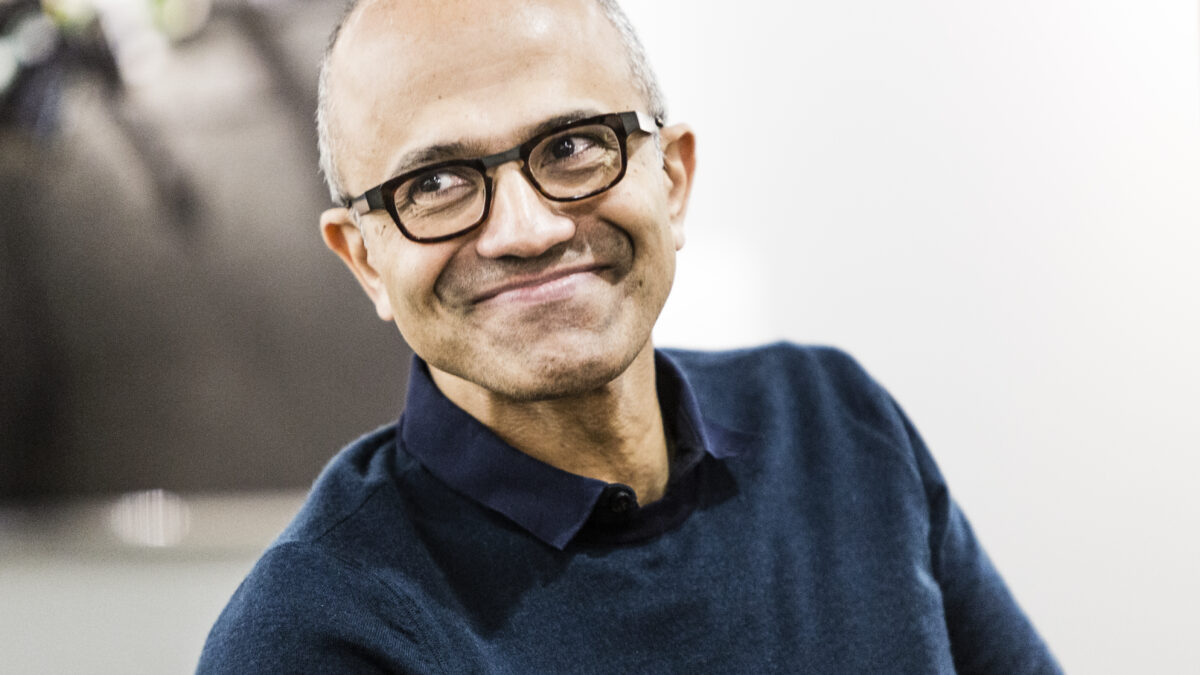
Satya Nadella is the chairman and chief executive officer of Microsoft, a role he has held since 2014 and 2021, respectively. He joined Microsoft in 1992 after working at Sun Microsystems and rose through engineering, online services, business software and cloud leadership roles.
Nadella’s career is closely associated with Microsoft’s shift toward cloud computing and subscription-based services. His public leadership has also emphasized organizational culture, empathy, collaboration and the idea that large technology companies must account for the social effects of their products.
Satya Nadella at a glance
- Full name
- Satya Narayana Nadella
- Born
- August 19, 1967, in Hyderabad, India
- Current roles
- Chairman and chief executive officer of Microsoft
- Joined Microsoft
- 1992
- Earlier employer
- Sun Microsystems
- Education
- Electrical engineering, computer science and business administration
What is Satya Nadella known for?
Nadella is best known for leading Microsoft during its transition from a company centered largely on packaged software and personal-computer platforms toward cloud infrastructure, enterprise services and artificial intelligence. Before becoming CEO, he led Microsoft’s Cloud and Enterprise group, where he was responsible for the company’s cloud infrastructure and services business.
Microsoft’s executive biography says Nadella helped lead a cloud transformation that outperformed the market and gained share from competitors. Earlier assignments included leadership of research and development for the Online Services Division and the Microsoft Business Division. He also served as president of the Server and Tools Business, a position tied to the company’s effort to connect Windows Server, databases and developer tools with its Azure cloud platform.
The broad outline of that career is supported by both Microsoft’s official executive biography and an overview from Stanford Graduate School of Business. Those accounts differ in emphasis but agree that cloud computing was central to his rise inside Microsoft.
How did Nadella become Microsoft CEO?
Microsoft named Nadella its CEO on February 4, 2014. He became the third chief executive in the company’s history, following Bill Gates and Steve Ballmer. Before his appointment, he had spent more than two decades at Microsoft in progressively senior technology and business roles.
His selection reflected the importance of cloud computing to Microsoft’s next phase. Nadella had experience managing large technical organizations as well as commercial businesses, and Microsoft’s official account describes him as a leader who could work across enterprise and consumer products.
At Stanford, Nadella described himself as an “unexpected CEO,” saying he had not imagined Microsoft without Gates and Ballmer actively involved. He said his leadership goal was to make the company’s purpose and culture more explicit rather than rely on the authority associated with its founders. That account is an attributed description of his own thinking, not an independent measurement of Microsoft’s culture.
Where did Satya Nadella grow up and study?
Nadella was born in Hyderabad, India, in 1967 and was raised there. He attended Hyderabad Public School, Begumpet, according to the biographical record summarized by Wikipedia. He later moved to the United States for graduate study.
His education is reported consistently at the graduate level: he earned a master’s degree in computer science from the University of Wisconsin–Milwaukee and an MBA from the University of Chicago Booth School of Business. The institution named for his undergraduate electrical-engineering degree is not presented identically in the supplied sources. Wikipedia identifies Manipal Institute of Technology, while Microsoft’s biography identifies Mangalore University. The safest summary is that Nadella studied electrical engineering in India before completing graduate degrees in computer science and business administration in the United States.
Before joining Microsoft, he worked on the technology staff at Sun Microsystems. Microsoft says he joined the company in 1992, beginning a career that included roles in online services, business software, server technology and cloud infrastructure.
What is Nadella’s leadership style?
Nadella frequently connects leadership with learning, inclusion and empathy. In his Stanford conversation, he described a preference for “learn-it-alls” over “know-it-alls,” drawing on the growth-mindset concept associated with Stanford psychologist Carol Dweck. He also identified diversity and inclusion, customer focus and operating as “one company” as important elements of Microsoft’s culture.
These are Nadella’s stated leadership principles, so they should be read as his account of the organization he wanted to build. They do not by themselves prove that every part of Microsoft operates according to those ideals. Still, they help explain the language he has used consistently when discussing Microsoft’s internal culture and business strategy.
Empathy is another recurring theme in his public remarks. Nadella has argued that understanding people’s unmet needs is part of innovation and product design. He has also connected accessibility and artificial intelligence, pointing to tools that can help people communicate, learn or interact with technology. His comments on AI include both advocacy for practical uses and warnings about bias, ethics and the need for human accountability.
What is Nadella’s role in Microsoft’s AI strategy?
As of August 23, 2026, Nadella remains Microsoft’s chairman and CEO, according to the company’s executive page. His public communications increasingly focus on artificial intelligence, cloud infrastructure, Copilot products, developer platforms and the broader economic effects of AI.
His LinkedIn profile lists recent writing on “frontier intelligence,” AI transformation and the future of work. It also shows him discussing Microsoft’s AI products and infrastructure in his own public posts. Those posts are useful evidence of the subjects Nadella is emphasizing publicly, but they are not independent evaluations of product performance or market leadership.
Microsoft’s AI strategy sits within the larger cloud business Nadella helped expand before becoming CEO. That continuity matters: his leadership is not a break from his earlier career but an extension of a long-running focus on platforms, developer tools, enterprise computing and infrastructure.
What should readers know about Nadella’s public profile?
Nadella is an Indian-American business executive whose public identity is primarily professional. Microsoft identifies him as originally from Hyderabad and says he lives in the Bellevue, Washington, area with his family. Public biographies also note that he serves on the board of trustees of the University of Chicago.
Some widely repeated biographical details concern his family and personal life. Those details are not necessary to understand his work, and this profile does not expand on private information or identify children. The relevant public record is his education, his more than three decades at Microsoft, his tenure as CEO and chairman, and his role in the company’s cloud and AI direction.
Nadella has also received major recognition in India, including the Padma Bhushan in 2022, according to the supplied biographical record. That honor is a verified distinction; broader claims about his influence or legacy remain matters of interpretation and should not be presented as settled fact.
Why does Satya Nadella matter?
Nadella matters because he has led one of the world’s most consequential technology companies through several overlapping platform shifts: from desktop software to cloud services, from licenses to recurring services, and from traditional software products to systems built around generative AI and digital assistants.
The strongest evidence for understanding his career is concrete: his Microsoft roles, the timing of his appointment, the company’s description of his cloud responsibilities, and his own public statements about culture and technology. The larger question—how much of Microsoft’s performance should be attributed personally to Nadella—requires more caution. A global company’s results reflect thousands of employees, acquisitions, market conditions, customers, competitors and regulatory decisions, not one executive alone.
In that sense, the answer to “Who is Satya Nadella?” is both straightforward and limited: he is Microsoft’s chairman and CEO, an engineer and business executive who spent his career inside the company and became closely associated with its cloud-first and AI-era strategy.
Related coverage about Satya Nadella
Satya Nadella’s significance is best understood through the platforms he helped build and the management ideas he has publicly advanced. His record combines long tenure inside Microsoft with a strategic shift toward cloud infrastructure and AI, while claims about his personal impact should remain distinct from the company’s collective performance.
Sources and methodology
- Microsoft executive biography: Satya Nadella: https://news.microsoft.com/source/exec/satya-nadella/
- Satya Nadella - Wikipedia: https://en.wikipedia.org/wiki/Satya_Nadella
- Satya Nadella - Chairman and CEO at Microsoft: https://www.linkedin.com/in/satyanadella