
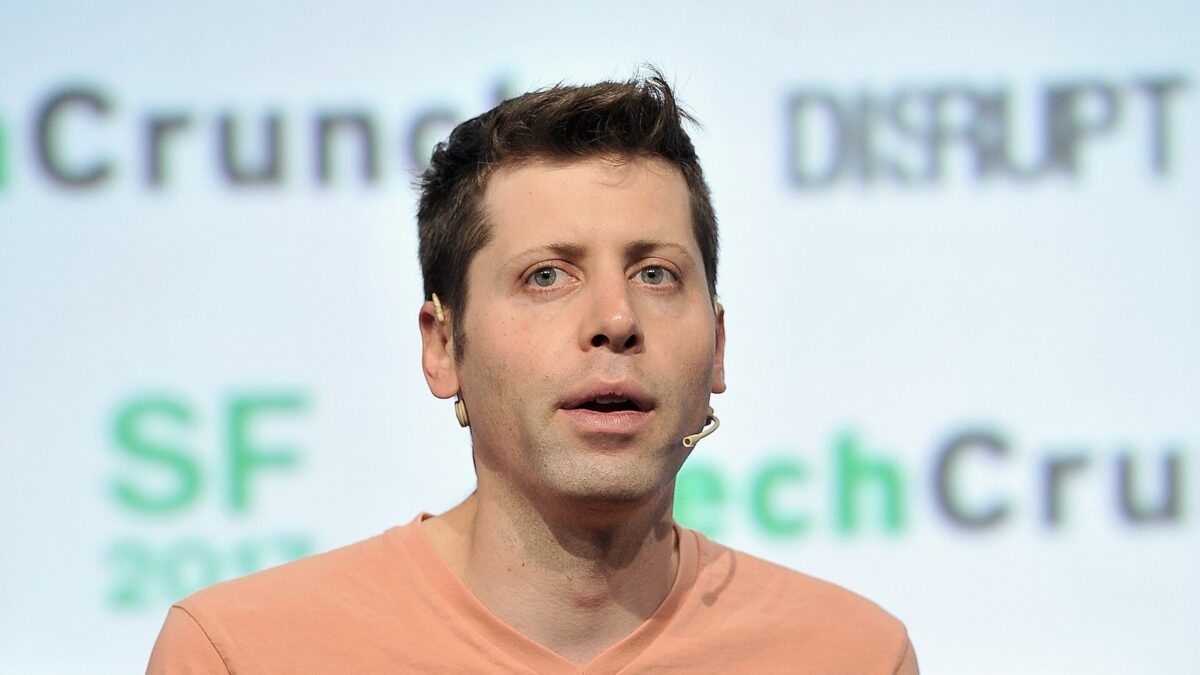
Sam Altman’s estimated net worth is $3.3 billion as of August 22, 2026, according to Forbes. His wealth is attributed primarily to venture investments rather than ownership in OpenAI, where he serves as chief executive officer. Fortune reports that Altman owns no OpenAI equity and has historically received a salary of about $76,000 a year, making his investment portfolio the central explanation for his fortune.
That distinction matters when assessing Altman’s career and business interests. His path to billionaire status did not come from a single company sale or a conventional executive compensation package. It developed through an early startup exit, leadership at Y Combinator, investment funds and stakes in a broad group of technology, energy and biotechnology companies.
For a concise overview of his broader background, see this Sam Altman profile. This article focuses specifically on the career decisions, companies and business ventures tied to his estimated wealth.
Loopt gave Altman his first major business exit
Altman began his professional career by co-founding Loopt, a location-sharing startup, after leaving Stanford University in 2005. The company developed a mobile application that allowed users to share their locations with friends, an idea that preceded the widespread adoption of location-based smartphone services.
Loopt raised tens of millions of dollars in venture capital but struggled to achieve significant user traction. Green Dot Corporation acquired the company in March 2012 for $43.4 million, according to Wikipedia’s summary of Altman’s career. Forbes similarly describes the transaction as a $43 million sale. The difference is a matter of rounding, not a separate reported event.
The sale appears to have been important because Altman used proceeds from Loopt to move from operating a startup into investing in startups. His career therefore shifted from founder to venture investor before he became widely known as the public face of OpenAI.
Y Combinator expanded his influence in Silicon Valley
Altman joined Y Combinator as a partner in 2011 and became its president in 2014. He held that role until 2019, when he left to focus on OpenAI. During his tenure, he worked to expand the accelerator’s reach, increase the number of companies it could fund and support more ambitious technology businesses.
Built In reports that Altman expanded Y Combinator’s cohorts, launched the YC Continuity Fund for later-stage support of alumni companies and helped establish YC Research. The accelerator’s portfolio included companies such as Airbnb, Dropbox and Stripe, although participation in Y Combinator does not by itself mean Altman personally owned those businesses.
His position at YC also gave him access to a large network of founders and early-stage investment opportunities. That network became a major part of his business career. Fortune reports that Altman and his venture funds have stakes in roughly 400 companies, citing the Wall Street Journal. The figure should be read as a reported portfolio estimate rather than a complete, independently audited list of holdings.
Hydrazine became a vehicle for investment wealth
In 2012, Altman co-founded Hydrazine Capital with his brother Jack Altman. The fund was named after a chemical used as rocket fuel. According to Wikipedia, the initial $21 million fund included much of the money Sam Altman received from selling Loopt, while Peter Thiel provided significant outside backing.
Fortune describes the Loopt proceeds as the foundation for Altman’s first venture fund and identifies Thiel as Hydrazine’s largest outside investor. Wikipedia reports that Altman invested a substantial portion of the fund in Y Combinator companies. These details help explain why his fortune is associated with investments rather than OpenAI stock.
The exact value of Hydrazine and its underlying holdings is not fully public. Wikipedia reported that Altman’s investment portfolio was valued at about $2.8 billion in June 2024, while Forbes listed his real-time net worth at $3.3 billion on August 22, 2026. Those numbers are estimates produced at different times and should not be treated as a precise statement of liquid cash or independently verified personal assets.
OpenAI made his career more prominent, not necessarily wealthier
Altman co-founded OpenAI in 2015 and became its CEO in 2019 after leaving Y Combinator. The company’s release of ChatGPT in November 2022 turned him into one of the most recognizable leaders in artificial intelligence. His role at OpenAI has been central to his professional profile, but the available reporting says it is not the direct source of his billionaire wealth.
Both Fortune and Forbes state that Altman has no equity in OpenAI. Fortune also reports a salary of roughly $76,000, although compensation can change and the article characterizes that figure as historical. OpenAI’s private-company valuation, fundraising arrangements and executive compensation are separate from Altman’s personal net worth and should not be conflated.
Altman was briefly removed as OpenAI CEO in November 2023 and reinstated five days later, according to Forbes and Wikipedia. That episode affected his leadership record, but it did not establish that he gained or lost a publicly disclosed ownership stake in the company.
His reported business interests span AI, energy and biotech
Altman’s investment interests extend beyond software. Forbes identifies stakes in Stripe, Reddit and Helion Energy as important parts of his wealth. Fortune reports that his portfolio also includes early investments in Airbnb and Stripe, while Wikipedia lists companies including Worldcoin, Instacart and Helion Energy among his investments.
Helion, a nuclear-fusion company, is often singled out in coverage of Altman’s finances. Fortune reports that Forbes has estimated his Helion stake at $1.65 billion. That figure is an attributed estimate, not a public-market price, because Helion is privately held and private-company stakes can be difficult to value.
Other reported investments include Retro Biosciences, a biotechnology company focused on cell restoration, and Humane, which developed an AI-powered wearable device. Altman has also been associated with Cruise, the autonomous-vehicle company, according to Biography.com. The existence of an investment does not necessarily indicate operational control, a board role or current ownership percentage.
His portfolio has also prompted questions about potential conflicts of interest because some companies connected to his investments may do business with OpenAI. Wikipedia reports that these questions were raised in connection with his investment portfolio, while also noting that OpenAI board chairman Bret Taylor said Altman had been transparent about his investments. The available sources do not provide a complete current register of his holdings or establish wrongdoing.
What the net worth estimate does—and does not—show
Altman’s $3.3 billion estimate is best understood as a snapshot of the reported value of his private-company and venture investments. It is not a salary-based fortune, and it does not mean he has $3.3 billion in readily spendable cash. Private stakes may be subject to restrictions, changing valuations and uncertainty about when they could be sold.
The clearest through line in Altman’s career is the transition from founder to platform builder and investor. Loopt supplied an early exit; Y Combinator widened his access to startups; Hydrazine organized part of his investment activity; and OpenAI gave him a global leadership role. His business story is therefore less about owning the company he leads than about building wealth through a large, early-stage technology portfolio.
Sam Altman’s fortune is primarily an investment story. His first company, Loopt, produced the capital that helped launch Hydrazine Capital, while Y Combinator supplied a broad founder network and early-stage deal flow. OpenAI made him globally prominent, but available reporting says he owns no equity in the company. Current net worth figures remain estimates because much of his wealth is tied to private businesses whose values and ownership terms are not fully disclosed.
Sources and methodology
- Sam Altman — Wikipedia: https://en.wikipedia.org/wiki/Sam_Altman
- Fortune: Sam Altman reveals the investing advice billionaire Peter Thiel gave him: https://fortune.com/2026/08/03/openai-ceo-sam-altman-investment-advice-from-peter-thiel-paul-graham-built-billionaire-wealth-no-equity/
- Forbes: Sam Altman profile: https://www.forbes.com/profile/sam-altman/
- Built In: Who Is Sam Altman? A Guide to the OpenAI CEO's Career: https://builtin.com/articles/sam-altman