
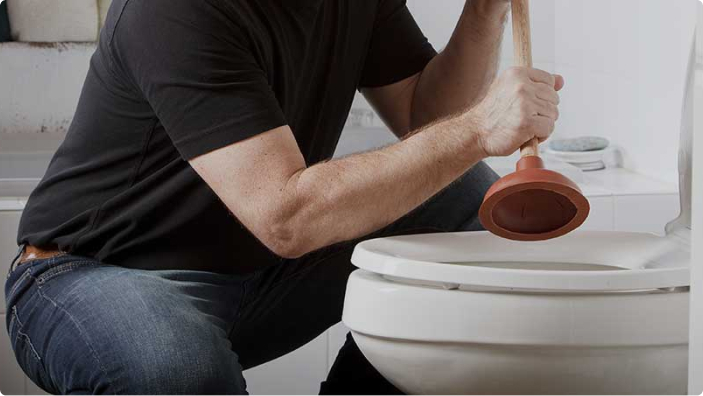
If you have no plunger, start by stopping the water supply and avoid repeated flushing. For a soft blockage made of waste or toilet paper, add dish soap, wait, and slowly pour in hot water that is not boiling. If the water level does not fall, the clog involves a hard object, or the toilet threatens to overflow, stop experimenting and use a toilet auger or seek professional help.
Stop an overflow before trying any method
Find the shut-off valve behind the toilet and turn it fully clockwise. If that is not possible, open the tank and check that the rubber flapper has closed. This prevents another flush from sending more water into a bowl that is already blocked.
Protect the floor and wear gloves before working around the bowl. The evidence also recommends ventilation. Do not keep flushing to see whether the problem has fixed itself: repeated flushing can turn a partial blockage into an overflow and create water damage.
Best first option: dish soap and hot water
Dish soap is the most practical no-plunger method when the blockage is soft and movable. The soap can lubricate the passage, while hot water may help loosen material. This is not a reliable solution for a toy, other hard object or obstruction that has become lodged in the trap.
- Add dish soap to the bowl. The supplied guides describe amounts ranging from several tablespoons to about half a cup or a cup.
- Heat water until it is hot but not boiling.
- Pour the water slowly into the bowl. Avoid a forceful pour that could raise the water level too quickly.
- Wait about 15 to 30 minutes before checking whether the level has fallen. One source says a tougher clog may need longer soaking, potentially overnight.
- Only test with one flush if the water has clearly lowered and the bowl is not near overflowing.
The amount of soap and waiting time vary across the supplied sources, so the conservative decision is to use enough soap to coat the water and allow time for it to work rather than repeatedly flushing.
Other no-plunger methods, with important trade-offs
Baking soda, vinegar and hot water
One official bathroom-product guide recommends adding baking soda, then white vinegar, allowing the mixture to fizz, and following it with hot water. Its instructions describe one cup of baking soda, two cups of vinegar, a 30-minute wait, and an additional 10-minute wait after hot water. Another official plumbing guide recommends letting a similar mixture work overnight.
This method is therefore a possible household alternative, but the evidence does not show that it will clear every clog. It should not be treated as a substitute for removing a hard object. Never combine household mixtures with commercial drain cleaners.
Toilet brush, bottle or wire
A toilet brush can provide limited physical agitation for a minor clog. A plastic bottle filled with warm water can be placed at the drain opening and squeezed to imitate some water pressure. These approaches may be messy and offer less control than a dedicated tool.
A straightened wire hanger can be inserted gently and twisted to break up a blockage, but the source warns that rough handling can scratch the bowl. Use this only when you can work carefully and do not push an object farther into the trap.
Wet/dry vacuum
A wet/dry vacuum is described as another option: remove water from the bowl, seal the hose with a towel and use suction briefly. This method has a clear equipment limit. Use only a wet/dry vacuum; a regular household vacuum is not an appropriate substitute.
When the answer changes
Household methods make the most sense when the likely cause is soft waste or toilet paper and the bowl is not repeatedly filling. They are a poor fit when a child’s toy or another hard item may be lodged inside, because soap and vinegar will not retrieve it. A closet auger or plumbing snake is designed for more resistant blockages and can help drill through or push past material.
Stop and escalate if the toilet remains blocked after a cautious attempt, the water level rises, or the suspected object cannot be reached safely. The supplied sources do not provide a service price, so the cost of professional help cannot be stated from this evidence. The decision is still clear: avoiding an overflow and preventing damage matters more than repeating an unproductive home remedy.
Preventing the next blockage
Use less toilet paper at one time, and do not treat the toilet as a trash bin. The supplied guidance specifically warns against flushing materials such as grease and wax that can solidify and create blockages. Regular bowl cleaning and keeping the water jets under the rim unobstructed may also support normal flushing performance.
The key test is not whether a method creates fizz or movement; it is whether the water level falls and the toilet passes one controlled flush without rising. If it does not, the problem has moved beyond a simple no-plunger fix.
A no-plunger toilet fix depends more on the type of blockage than on the number of household tricks available. The supplied evidence supports dish soap and hot, nonboiling water as the clearest first attempt for soft material, while hard objects require a different decision. Stopping the water is the shared safety step because repeated flushing can cause an overflow. Baking soda and vinegar, a toilet brush, a bottle and a wet/dry vacuum are alternatives with narrower limits. The answer changes when the water rises, the clog persists or an object may be lodged in the trap.
Sources and methodology
- How to Unclog a Toilet Without a Plunger: 7 Methods - Toiletseats.com - https://www.toiletseats.com/education-and-inspiration/articles/how-to-unclog-toilet-no-plunger
- 4 Ways to Unclog a Toilet With & Without a Plunger | Liquid-Plumr® - https://www.liquidplumr.com/diy-plumbing-tips/how-to-unclog-a-toilet
- Here's how to unclog a toilet without a plunger - Reviewed - https://www.reviewed.com/bath/features/how-unclog-toilet-without-plunger
- Three ways to unclog a toilet—with or without a plunger - Bungalow - https://bungalow.com/articles/three-ways-to-unclog-a-toilet-with-or-without-a-plunger