
Healthcare providers and distributors, not ordinary household consumers, are the primary audience for this recall. Baxter announced a voluntary nationwide recall on Aug. 25, 2026, for two lots of 0.9% Sodium Chloride Injection, USP, supplied in 500 mL VIAFLEX plastic containers. The reason is the potential presence of fiberglass particulate matter. Facilities should stop using any unit that matches the verified recall identifiers, separate it from usable stock and follow their established return process.
The FDA describes the product as a source of water and electrolytes and says it may also be used as a priming solution in hemodialysis. The product is administered intravenously or used in medical procedures, so the recall is not a typical consumer product withdrawal. The immediate decision belongs to hospitals, clinics, pharmacies, distributors and other organizations that purchase or hold IV supplies.
What the contamination could do
The safety concern is mechanical as well as inflammatory. If fiberglass particles enter the bloodstream, they may obstruct or clot blood vessels. The FDA says that blockage could cut off blood flow to vital organs, cause a life-threatening blood clot in the lungs known as a pulmonary embolism, and result in permanent organ damage or death. The agency also lists local vein irritation, an inflammatory reaction, aggravation of preexisting infections and allergic reactions as possible consequences.
That risk statement describes the potential harm from administering contaminated product; it does not establish that every recalled bag contains particles or that a patient has been injured. Baxter said it had received no reports of adverse events connected with the issue as of Aug. 25, 2026. That absence of reports is a status update, not evidence that affected units are safe to use.
How facilities should identify affected inventory
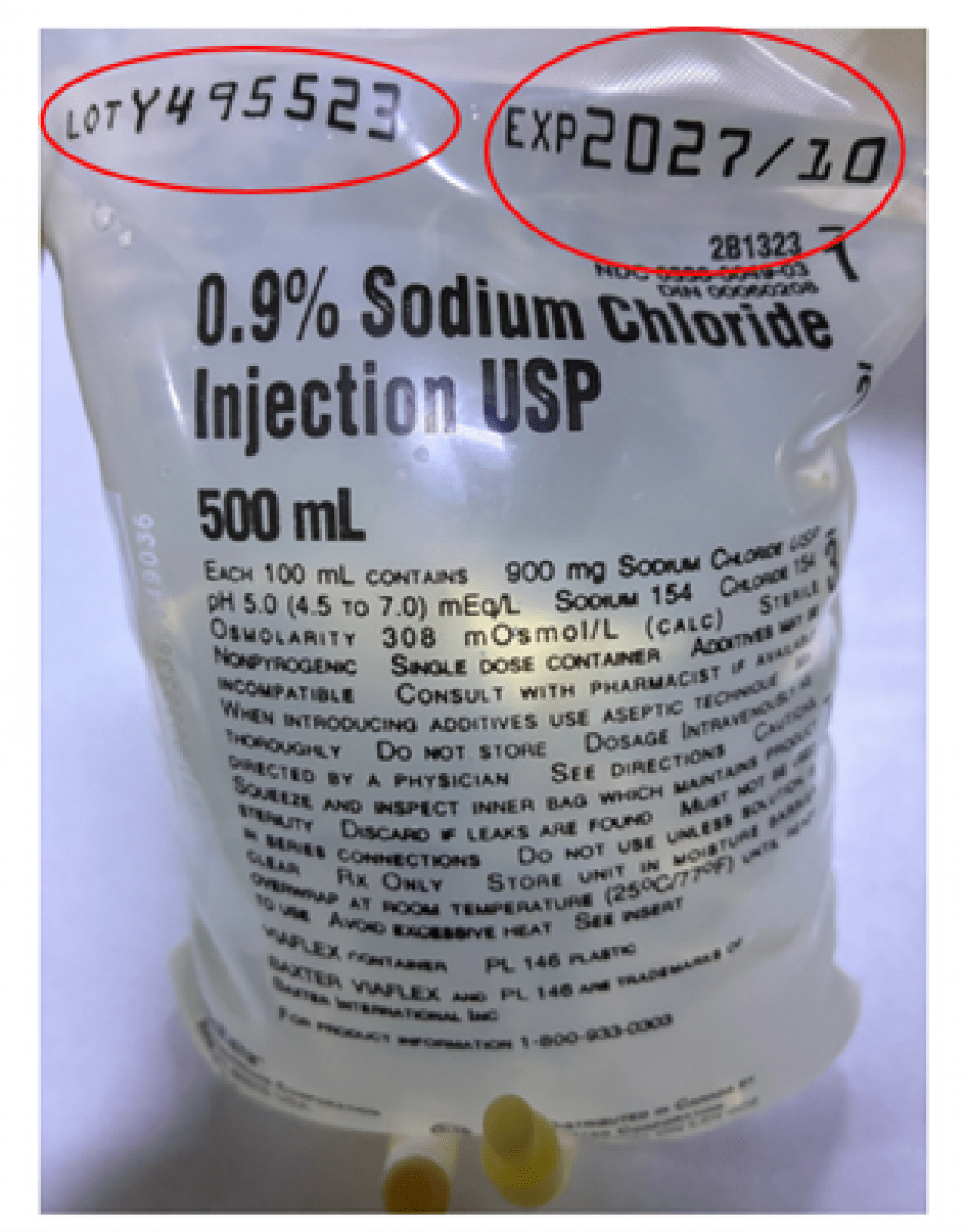
The FDA identifies the recalled product as Baxter 0.9% Sodium Chloride Injection, USP, 500 mL VIAFLEX Plastic Container. An independent report identifies product code 2B1323Q and reports two lot numbers. However, the supplied secondary coverage is not consistent: one report renders the lots as Y495523 and Y495523A, while another renders them as Y49552 and Y49552A. Because the FDA text supplied here does not show the complete lot table, those conflicting transcriptions should not be treated as interchangeable.
Facilities should therefore compare the product code, container description and lot information printed on each unit or case with the complete FDA or Baxter recall announcement. Do not clear inventory based only on the words “0.9% sodium chloride,” the Baxter name or the bag’s appearance. A product match requires the relevant identifier, and the lot-number discrepancy makes direct verification particularly important.
What to do with a matching product
- Stop use. Discontinue administration of units confirmed to match the recall notice. Do not use visual appearance alone as a safety test.
- Quarantine the stock. Separate affected bags and cases according to the facility’s medication or medical-supply recall procedure so they are not issued accidentally.
- Document the inventory. Record the product description, product code, lot information, quantity and location before arranging the return. The evidence supplied does not establish a consumer refund amount or a universal reimbursement process.
- Follow the facility’s return instructions. Baxter’s announcement directs customers to return affected product according to their procedures. The evidence pack does not provide a recall deadline, so facilities should not assume that a deadline or payment is available without confirming it in the current notice.
- Escalate patient concerns through clinical channels. Anyone who may have received a recalled product should contact the treating healthcare provider or facility for individualized medical guidance. The recall notice’s potential harms are serious, but the supplied evidence does not establish that exposure occurred in any particular patient.
Why the product code and lot number both matter
Recall identification works by narrowing the affected inventory to the specific product and manufacturing lots. A facility that checks only the product name may quarantine unaffected stock or, more seriously, miss a recalled unit with the same general description. Conversely, a facility that relies on a copied lot list without checking the primary notice could act on a transcription error.
The independent coverage says the recalled units were distributed between July 31 and Aug. 3, 2026, to healthcare providers and distributors in 14 states, including Louisiana, Texas, Florida, Illinois, Indiana, Maryland, Missouri, North Carolina, New Jersey, Nevada, New York, Ohio, South Carolina and Virginia. That distribution detail may help organizations prioritize their review, but the FDA or Baxter notice remains the controlling source for the complete affected-customer and lot information.
What remains unverified
The supplied evidence does not establish a universal patient notification requirement, a confirmed source of the fiberglass, a refund amount, a final number of affected units or a deadline for returns. It also does not show confirmed injuries associated with the recall. Those facts could change if Baxter or the FDA publishes an updated notice, adds adverse-event information or clarifies the lot identifiers.
For now, the responsible decision is narrow: healthcare organizations should verify the complete identifiers against the primary recall notice, remove confirmed matches from use and follow Baxter’s documented return process. Organizations should not broaden the action to every saline product solely because it is a Baxter product or a 0.9% sodium chloride solution.
This recall is primarily an inventory-verification problem for healthcare organizations, not a household product alert. The FDA confirms the product, recall reason and potential clinical consequences, while independent coverage adds a product code and distribution context. The key evidence boundary is the lot number: the supplied secondary reports transcribe it differently, and the available FDA excerpt does not display the complete identifier. Facilities should therefore verify each unit against the current primary notice, quarantine confirmed matches and follow Baxter’s return instructions. No deadline, refund amount, confirmed injury count or universal patient-notification rule is established by the supplied evidence.
Sources and methodology
- Baxter Issues Voluntary Nationwide Recall for Two Lots of ... - https://www.fda.gov/safety/recalls-market-withdrawals-safety-alerts/baxter-issues-voluntary-nationwide-recall-two-lots-09-sodium-chloride-injection-due-potential
- FDA recalls IV bags over possible fiberglass risk - https://www.ktalnews.com/health/baxter-sodium-chloride-recall
- Baxter Recalls Two Sodium Chloride Lots Over Fiberglass - https://www.pharmanow.live/latest-news/baxter-recalls-sodium-chloride-injection-fiberglass-particulate-contamination-2026
- Sodium chloride injections recalled, may contain fiberglass - https://www.uppermichiganssource.com/2026/08/27/sodium-chloride-injections-recalled-may-contain-fiberglass